People don’t know what to expect from this strange thing called “anime,” but they do know what to expect from Toonami: accessibility and action.
Deadman Wonderland has plenty of the latter, added and stirred with a cup and a half of good ol’ fashioned manipulative nihilism. Bake at 400 degrees. Ding. You now have your very own incredibly dumb, barely competent, and completely enjoyable exercise in blood, half-way bildungsroman, and what the hell, here’s some more blood, because we’re cool like that.
Ganta is a nice little ordinary middle school kid. So naturally, his whole class is violently slaughtered, and he’s pinned with the crime. Innocent as he is, few judges are on the circuit who are inclined to believe testimony alluding to a murderous phantasmic “Red Man” who, according to Ganta, implanted a red crystal in his chest. The villainous DA, who obviously knows exactly whats up and further frames him for the crime, does nothing to help. So Ganta gets interred in a privately owned prison called Deadman’s Wonderland (and everyone’s okay with this, apparently) where everything is awful, and he meets a mysterious albino girl in a skintight body suit who immediately greets Ganta as her bestest buddy.
So basically, a not particularly unusual shonen adventure setup. The grownups are terrible, the girls are well endowed, and the kid is special. Why, then, is Deadman Wonderland as enjoyable as it is?
Not because it’s any good. A drama starts and ends with its characters, and Shiro and Ganta are flat. We never really find out that much about them, or why they are the way they are. They wear their motivations on their sleeves, and they seem to feel things out of habit than actual emotion. I seem to remember all of about three emotions from Ganta, and most of them have to do with the fact that the show is doing everything it can to make the guy miserable.
And the show goes out of its way to do so, to the point of completely, almost naively transparent contrivance. Why is the friendly, decent guy introduced? So he can get stomped on with a stiletto heel. Why must Ganta consume antidote “candy” to stay alive? Because it’s dramatic. Why does anyone do anything in this whole show? Because the director had one burning question he wanted answered during this production: how do we make it more dark?
Deadman Wonderland is a show that revels in its own nihilism, trying to one up itself at every corner. Yet in the end, the show reveals it actually has a theme.
What’s that theme?
You have to reject nihilism…to reject nihilism.
A theme that it states boldly and with supreme and utter self confidence, as if it were the most brilliant realization in all of human history.
And that’s what makes it so special. It has the audacity to be a stupid piece of crap. At no point did it feel like this was something that came out of a production committee. The director’s semi-competent fingerprints are all over this show, and while the result is intensely dumb, it feels like a special kind of dumb that will never be reproduced anywhere else. It is a show as written, it feels, by an edgy teenager, for other edgy teenagers to marvel at.
Miraculously, the show is also halfway competent on the technical side. It’s paced decently, the dub is just good enough to get by, and all the little filmmaking details are all there. All this helps make all that’s stupid with it watchable, instead of simply boring.
For the weapons that require you to cut yourself to use. For the dumb OP song. For Greg Ayres doing his best Shinji impersonation. For the complete tone-deafness to theme. For the complete lack of anything like self-moderation. For all those things, I loved this show, in spite of itself. It’s pretty hilarious.
Wargame: European Escalation
Obviously, by “one post a day,” I meant “one post after about a week of chilling with friends, drawing, and trying to decide how I feel about going back to college.”
Also, playing vidya.
Specifically, I’ve had a bit of a problem. I used to play a lot of a mod for the old game Command & Conquer: Generals called Cold War Crisis. As you may guess, it’s set during the 80s, and involves conventional warfare with the Soviets. Think Red Storm Rising.
In the real world, had the Soviets ever decided to roll across the Fulda Gap into West Germany, they’d be rolling in under a fog of deadly chemical weapons and would have likely trounced NATO forces in Europe in about a week. Assuming things had not already gone all fission-y.
Fortunately, as this is a game, NATO is strangely well-supplied, and the thousands of chemical and nuclear weapons have been thankfully ignored, allowing you, the player, to command your armored division with impunity.
Note how I use the past tense.
When I got my new laptop, it came with OS 10.7, a user friendly but problematic OS that, among other things, broke the Cold War Crisis mod. If this were merely a configuration problem, I could fix it myself, post the fix on the internet, and be a minor sort of hero, but alas no. The problem is with the launcher, which only the CWC team would be able to fix.
I enjoyed the style of game, and I wanted a replacement. Unfortunately, none presented itself on the mac, but on the PC, I found Wargame: European Escalation.
A game developed by people who hate the letter “s.”
Compared to the CWC mod, it’s a much more tactical game. You control objectives, earn points, and use them to bring in reinforcements. Vehicles use roads to move faster, tanks run out of fuel, and using transports to move around infantry actually makes sense on these huge German expanses. Given how much you’ll need to be shuttling supply trucks and reinforcements to and from the FOB, the game is as much about logistics as tactics.
It plays on very large maps, but it still conserves individual unit detail. Unfortunately, unless you’re running on a very good computer, you won’t see much of that detail. I’m actually experiencing some rather unfortunate texture glitches, but I think that’s the fault of something I did to the configuration.
With the added dimension of realism, I’m having to get used to thinking with practical tactics, and learn more about cold war era weaponry. For instance, hiding a squad of Panzergrenadieren with MILANs in the trees to fire on approaching armor is a good idea, but their missiles are manually guided. That means, even though they can engage at significant ranges, they will almost always miss even a sitting target, wasting all their missiles. You have to tell them specifically to hold their fire until the armor gets closer.
On the other hand, micro is more difficult to pull off. I have yet to be able to maneuver my tanks into a “hull down” position (stopped behind a hill so just the turret is visible over the crest). Though tanks have different amounts of armor on different sides, there’s not really much of a way to make sure they’re facing the right direction. Most tank battles seem to come down to who has the better tanks and crews.
Playing skirmish agains the AI is fun, though on easy, it makes some weird choices.
I once found myself moving up my armor to defend two middle objectives when all of a sudden the AI decided to bring out all the MI-2s ever. I had about three units of four Leopard L4s, and two of them routed under the hundreds of rockets that were coming down on them from all directions. It worked for the AI. But then my Gepards arrived and all of a sudden it was full of burning MI-2 wrecks.
Later, I was playing, and it decided to camp around…somewhere. I’m not sure where all its forces were, if it even brought any in, but I sent in a recon helicopter to scout their FOB. There was nothing there except the command vehicle, which got destroyed, securing victory.
Most of the time, it’ll simply bring up lots of tanks with scout vehicle support and some anti air in the back. Woe to any tank elements that get caught out of position, but with some scouting and good preparation, its armored pushes stall pretty quick by better quality tanks with infantry, helicopter, and logistical support. The first time it tried this, a unit of Leopard L4s and two of L3s got caught behind enemy lines with no support against about five units of T-55s. The tanks took more than 50% casualties, but the remaining tanks held out, because the AI didn’t stop to deal with them. So they followed them and took shots at their rear while two more units of Leopards came to reinforce the other side of a rather obvious choke point they were headed for while artillery fired ineffectually in the general direction of the advancing armor.
So anyway, it kinda sucks that it’s on the PC, but it’s a good game. I’ll definitely be playing a lot more.
Did I mention you’d be spending a lot of time watching tanks drive down the Autobahn?
(I recently made myself a tumblr to post things that I didn't feel warranted essay length entries here. I have aggregated some of it in this article)
C82#01: 幻想郷茶房~tea for two~ - 10th Avenue Café
Sometime early this morning, the first uploads from C82 began appearing on /jp/, slowly but steadily. It will likely take at least a week for even half of the stuff I actually wanted to listen to starts appearing, but I am a patient fellow (though that cruel, cruel premature upload thread was hard to deal with). I have the Tokyo Active NEETs album downloading as I’m writing this, but for now, I’m trying out some stuff that went under my radar.
I had never heard anything by the 10th Avenue Café before, but there were some familiar names on the credits. Miki - the vocalist on Close to You - I seem to remember from somewhere. The mastering was done by Shibata Takahiro of ShibayanRecords, a very familiar name indeed. His Bossa Nova albums show an interest in lighter, jazzy music, in contrast to his very heavy electro that most know him for. It is not surprising, then, to see him working with the 10th Avenue Café.
This album is rather short, but I feel like a longer album would overstay its welcome. There is, after all, only so much smooth jazz you can listen to at a time and not become a little bit bored. As ambience though, it works wonderfully.
Unfortunately, smooth jazz is hard to talk about in any interesting way. The arrangement makes heavy use of electronic instrumentation for harmonics and backup, but the melodies are primarily carried by piano (or keyboard) and vocal. In terms of license, the arrangements take very little: it’s very easy to tell what songs are arrangements of what originals.
The mishmash of backup elements could, if handled poorly, end up sounding off, but as unchallenging as the arrangements are, they are also masterfully done. That the tracks sound like anything at all is impressive: for soft jazz, it has a fair measure of soul in it.
Mood stays more or less consistent across the album - another reason for it to be short. Albiet, the first two tracks make more use of funk guitar and harmonics than the last two. Forest Calling especially seems to be the most focused on rhythm and groove of them, containing a piano riff that covers an unexpectedly broad range of octaves for a soft jazz arrangement.
In the end, I’m not sure how much I’ll end up listening to this, but it’s eminently pleasant, if just as eminently unchallenging. C82#02: Mythology - Sound Online
Remember Sound Online, guys? The guy who Alstroemeria Records and REDALiCE would team up with to make those triparte albums way back when? Fun times. He doesn’t seem to be doing all that much on his own of late. His last album was six tracks: three with vocals, three instrumentals. This appears to be his new business model, and it appears to be working out for him.
I keep up with his releases, but I really don’t get exited by his stuff. He had, back in the day, a very clear style. Very clean sounding instrumentals and ambient reverb were dominant. In the present day, his work seems to have taken on more rock influences than were present in his heyday of co-releases with RAMM. I do not care as much for this new direction, but he still has his moments. Perhaps Tsubaki is no longer hitting his stride as he used to, but he isn’t down for the count yet.
Since it’s a short album, I’m going to be all unprofessional and do a track-by-track. Sorry y’all.
We see what this new direction means in the first track - 春暁ストライド - with an arrangement that features prominently guitar backing and a rock style drum kit. In a way, it reminds me of a faster, less intense Cytokine, before he went heavier to the electronic side of things. 3L delivers excellent vocals, as always, but as a whole, it lacks progression, either rhythmically or melodically or in pacing. It starts off as it ends: rapid and with little in the way of tonal contrast. It’s okay at the outset, but it gets rather tiring quickly.
The vocal version of Borderland has some problems keeping itself integrated. The synth work does not flow well with Nachi Sakue’s vocals, which, because she’s Nachi Sakue, are in moé timbre. The combination of squealy dancefloor synth and squealy voice doesn’t work. However, the instrumental version largely solves this. We discover, in the vocal-less version, a throwback to SO’s older work. The underlying arrangement is actually both ambient and powerful, like his best days.
The third track - 白銀桜花 - handles its vocals far better. Aki Misawa does not sing in moé timbre, and mostly sticks to octaves she can reliably hit. It also helps that the background arrangement is more subdued, primarily consisting of continuo, piano, and placid electronic drums. On the instrumental version, this makes it a more ambient piece than the others. Some added electronic flute and synth work makes it work well enough, though at 4:23, it runs the risk of overstaying its welcome slightly.
So, just like his last album, we have two kinda passable tracks, and a pretty good one. Is it worth it? Maybe. Do I wish Tsubaki would pick up his game? Yes, but honestly, I know nothing about the man himself, or whether this is his full time job, or simply a diversion. If it is a diversion, it is a good one. If not much more than that.
C82#03: 東方爆音ジャズ3 - 東京アクティブNEETs
Okay, our first full length album!
As a fan of hard jazz and fusion, I am rather surprised I never came across these guys before. However, I am glad I did.
Despite being a fan of it, I am unfortunately not very well acquainted with the technical side of jazz, which makes it hard for me to talk about it very engagingly. Since the jazz almost writes about itself, putting into words that which comes intuitively from the music is impossibly difficult, so I won’t even try to do an analysis of any individual songs.
Instead, I do give a hearty recommendation just from the outset to go and check out the album if you like either hard jazz or Touhou. If you live in Japan, buy this shit.
I still have observations about it though. NEETs’ interpretations are excellent, but they feel very strange when they’re quoting ZUN directly. It encounters the same phenomena as Shostakovich’s singularly odd jazz album: the strong classical tendencies find their ways into the piece and end up overpowering the jazz-ness, converting it into some sort of hybrid. In some contexts, this would ruin the soul of the thing, but here, everyone’s playing with enough style and cohesion that it never feels like it’s departing the jazz envelope.
Still, the juxtaposition of ZUN’s neo-romanticism with the flow of the jazz itself means that this is a very, very different beast than, say, Kind of Blue. It’s melodic and tonal in ways that BeBop generally isn’t. Which is because, it’s not consistently BeBop. It falls into the softer end of the scale (though never into soft, and never at the cost of its complexity) from time to time, just as it sometimes treads the border of fusion. It brings variety, which is always a good thing. Never once was I anywhere even close to bored with this album.
I couldn’t help but feel slightly disappointed in their interpretation of Greenwich Upon the Heavens. In its original, it’s already a track highly suited to jazz arrangement, but the NEETs’ interpretation doesn’t really play that up. Though “this truly spectacular music isn’t as spectacular as it could be” is hardly a complaint.
So if you couldn’t tell already, this is a godly frakking album, and you should, like, listen to it right now.
So, all the albums I had assumed would be showing up last are the ones that were showing up at the outset. The Tokyo Active NEETs’ album, and ButaOtome’s Bowling both were on the first day, but Alstroemeria Record’s new album is still nowhere to be found.
On the other hand, this gives me time to enjoy each in turn, and even more time to write a short something about it here, before going onto the next thing.
C82#04: Crimson Tempest - REDALiCE
REDALiCE is one of those guys. Occasionally, he’ll have something really neat, and occasionally, he’ll just kinda…pass by. Back in the day, he and Minoshima of Alstroemeria Records would do a bunch of collaboration, but I haven’t seen them working on Touhou much together. What they did work on, however, was the ED to the spring’s Haiyore, Nyarlko-San, I’ll Absolutely Be With You (or something like that). Which, unfortunately, isn’t all that great (hey, kinda like the anime itself).
I wish I could say this album goes to show that REDALiCE still has it in him. It…kinda doesn’t. Admittedly, the style of most of the album is not one that greatly appeals to me, so I’m having a hard time separating the technical genius from my personal taste, but honestly, not a whole lot of it was particularly interesting listening.
The problem is mostly with his vocal stuff. A very (surprisingly) wide variety of vocalists show up on this album, from the familiar Nomiya Ayumi to the less familiar Rizuna. For the majority of the songs, REDALiCE has them sing in moe timbre. And honestly, that’s probably what, say, Nachi Sakue is best at. At the outset, this is unpromising for my own tastes, but it also seems that, on the vocal tracks, REDALiCE’s arrangements get a lot less interesting as well. Either that, or the mastering is such that they get overpowered by the vocals.
This is, of course, a generalization. Some songs work considerably better than others, and some are actually rather good. Your mileage will vary on which ones, but, having put the album on shuffle while writing this, the current song, Hungry Girl, is very nice in both how it phrases the vocals and the way it contrasts tones.
On the other hand, the two vocal-less, j-core oriented tracks on the album, are pretty neat. It is what he’s good at, and it’s what I listen to his albums for. If he delivers at nothing else, he delivers at that.
So far, I’ve talked only of REDAliCE’s own tracks, but he shares almost 40% of the album with guest arrangers: t+pazolite, ARM of IOSYS fame, and someone named Gennya, who is as of yet unfamiliar to me. t+pazolite has two tracks, similar in their flaws to REDALiCE’s own, and neither one of which I particularly care for. In truth, I have not heard enough t+pazolite to compare it to his normal, but I have not been too thrilled with his work that I have heard. ARM’s track is…well, he’s IOSYS, so that means crazy out-of-character humor. And indeed, that’s exactly what it is. At least, the fragments I actually understood. Gennya sounds like what I’d imagine Sound Online would sound like if Tsukasa did happy hardcore. Which isn’t terrible, but the track doesn’t really go anywhere either.
All told, I’m not really a fan of this album. A lot of the tracks don’t really go anywhere, and about 70% of it is rather underwhelming in general. I’m not writing off the whole album, but if you’re really interested, wait for some of it to get uploaded to youtube, then decide if you want to buy it/download it/get low quality rips of it from youtube.
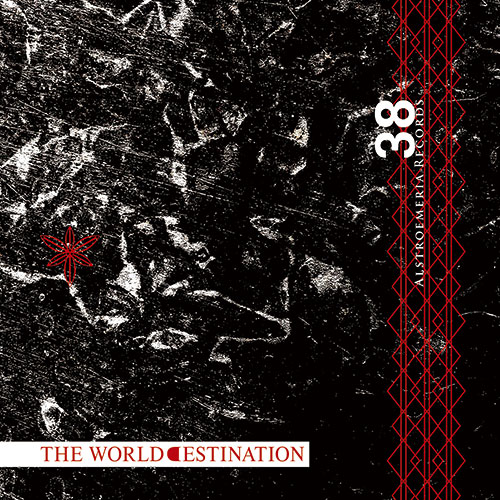
C82#05: THE WORLD DESTINATION - Alstroemeria Records
I had intended on writing something about every album I listened to from C82. I had this notion that I’d just write brief blurbs about stuff I hadn’t been anticipating. How silly of me, I don’t do ”brief.” I only do long, convoluted, and flowery.
I listened to Bowling, but I want to make sure I can’t actually purchase it legally before writing about it. I’ll give it a while. Maybe do that one last. I’ll go ahead and say this though: it’s really, really good. As if that were ever in doubt.
So as of now, I have a few albums I need to write about:
xi~on’s 12th Spell Card
EastNewSound’s Blaze Out
TAMusic’s Touhou Quartet 7
Unlucky Morpheus’s Parallelism α
And this one.
More widely known as The Granite Countertop Album (Not really)
It’s actually a nice change of pace from tats’ normal covers, and it’s not just the cover that’s changed either. This is not one of Minoshima’s “Dancehall” albums (see Haunted Dancehall, Killed Dancehall, and Abandoned Dancehall, his previous three). Unlike them, it is separated into distinct tracks rather than a continuous play. Because of this, Minoshima has more freedom in terms of sound and tone diversity, since they need not lead into each other as smoothly.
He demonstrates this with his first track, an original. Brostep. I am not a fan of brostep (most of it has all the subtlety and art of a power drill), but I do not shun it, and this is a pretty good example of how to do it in a way that doesn’t get annoying fast. More importantly, I don’t think Minoshima has ever done straight up brostep before.
As a whole, the album is heavier than the usual for Minoshima. It sounds more like Plastik World than Abandoned Dancehall at times, though the electro and brostep influences are definitely still there. It’s definitely still nu-Minoshima, but I think he’s taking slightly more risks with this album.
Most of the tracks have something interesting in their conception, and though towards the longish side, none of them really and truly start to drag. At seven minutes, YOU’RE MINE almost runs into this, but it’s an improvement on some of his other longer tracks (like Plastik Mind).
Minoshima seems to have started working more with a producer called Camelia. He is not a Touhou arranger and does not have a circle of his own: he produces Vocaloid albums. Moreover, he produces pretty good Vocaloid albums, from the one that I listened to, but I’m glad to hear him use real people on Minoshima’s albums. A funny artifact of his background is that his vocals still sound like they were written for Vocaloid, a sense reinforced in his track - IN THE FLICKERING - from the processing he did to it. The vocalist, Takanashi Toriko, does well in following Camelia’s baroque and demanding score.
I honestly was rather skeptical of this album, when I heard the crossfade. I was anticipating it regardless because I trust Minoshima to, at the very least, fail in an interesting way, but I was only expecting maybe a few good tracks. THE WORLD DESTINATION, as it turns out, is not only pretty good, but very good. Recently, I’ve wondered why it is I still hold Alstroemeria Records in such high esteem, especially compared to Shibayan and Syrufit. I no longer wonder.
C82#06: Parallelism α - Unlucky Morpheus
I think I’m gonna make myself only do one of these a day. Otherwise I’ll burn out and start getting boring.
Well, more boring.
That, and I want to do at least some actual fiction writing this summer.
Today’s album comes to us providence of Unlucky Morpheus. My first exposure to Unlucky Morpheus was Rebirth, a 2009 album. Rebirth was primarily speed and power metal, with vocals. It was pretty okay, and I never listened to it all that much. I paid them no attention until last Comiket, when they released Faith & Warfare, a fusion album. It was surprisingly really good. I just assumed that they were better at fusion than they were at actual metal.
Still, they made me curious, so when this Comiket came around, I went ahead and listened to this.
What I got was this.
It seems that in the interim, Unlucky Morpheus not only got a hell of a lot better (providence of some roster changes, I believe), they morphed into Dark Moor: Touhou Edition. Specifically, Dark Moor when they had Elisa Martin, though they too brought on a male vocalist for a few tracks.
I am at a loss to provide much more criticism than that. The team of Fuki and Yuki have gotten better at making interesting arrangement, and the newcomer vocalist - Denshirenji “Most Dangerous” Takeshi - has a powerful and emotive voice (I…err…actually mistook him for a girl at first). The drummer, who previously on Rebirth did little more than a straight and tiring double base drum attack and was the source of most of their problems, has either gotten much better, or left. The percussion on this album is still not its high point - it’s a bit stiff and still pretty basic - but it’s serviceable and allows their high points to show.
That isn’t to say that the album doesn’t have one or two problems. Yuki makes the questionable decision to try to sing in English for Inside of Me. Yes, she still sings pretty well (if a bit too emotively), but I haven’t the faintest what she’s actually saying, and it does stick out to a native speaker. The album itself is also mastered rather poorly, though it is not too egregious, and a good sound system or pair of headphones will help.
But those things aside, if you like power metal, go for it. Demetori has the harder end of the spectrum filled out (here’s hoping to C83!), and xi~on has the progressive metal handled, but besides for Sound Holic’s two pretty-good metal albums, we’ve lacked a really consistent vocal metal act. Perhaps, until now.
So I've been considering whether I really want to write about the stuff that came out of Reitaisai or not, and truthfully, I don't think writing about music is particularly compelling either to the writer or the reader, and I don't think that I'm particularly good at even that. I never write quite what I want to write about the album, and I'm never satisfied with the result. Honestly, neither should you, if you know anything about music or writing. Still, I might as well write something.
Reitaisai 9 was very successful. I do not know much about the games that came out, nor the manga - that'll all be scanlated later (and my Japanese is barely decent enough to get through a four panel comic strip), but the music and PVs were almost invariably awesome. I'm going to get to the music, but I really want to try something new here and talk about the PVs: two, specifically.
東方夢想夏郷 - A Summer Day's Dream, Second PV
Remember way back when, I talked about those two independent anime projects, both of which were flawed but progressing with new episodes, supposedly? Probably not, unless you're a Touhou fan reading this, so here's the brief version. The first project is produced by a studio called Maikaze, who released their first episode a few years ago. It was...not very good, for a couple of reasons. Maikaze hired big-name voice actors for their cast of not particularly well written characters, going through their not particularly interesting plot, in a singularly ugly looking world, observed poorly by a poor director. Yet, a 30 minute Touhou anime episode is still a pretty cool thing, and it's a good thing that, now, we are still assured that progress is being made on the second episode! What's particularly amusing about this is that they seem to be funding the production by selling the trailers on DVD. It's a strange sort of crowd funding: produce a trailer, and if the fans buy it, then it gives them the money to follow through. They're certainly taking their time with this one though. I can't say I blame them either: they took the cheap route the first time and we ended up with crap. And, from this new trailer, they seem to be in a good...ish way.
00:27 - Okay, Reimu's hand doesn't have one too many fingers anymore! Good sign, good sign. 00:32 - *sigh* They're still going with little kid Suika. These guys did play the games, right? 00:49 - My god, it even sounds like an anime theme song. ...not a good anime theme song, but... 00:57 - "Aright so in this scene, you watch the moon dramatically, then turn!" Looks like we got the same director alright. 01:10 - Sweet watch. 01:12 - Alice Margatroid's in this one. Lots of weird looks of ennui in this trailer, but Alice makes it look awesome. 01:16 - No really, why is Youmu naked? And have the body of a 12 year old? 01:20 - Ah, she was taking a shower before her fight scene! I must say, this opening shot kinda impresses me. They're definitely getting better at this. 01:27 - Not that their editing has improved by too much, but eh, it works. You know, I just read a manga called Youmu vs Udongein. An Imizu work, of course. 01:35 - Yep, the animation quality is definitely better this time around. Now it looks like a low-ish budget television anime rather than a low-ish budget indie production. 01:39 - Player 2 Reimu? Well, I guess she has to have other clothes.
So yeah, I'm exited. It's going to suck, but I don't care, because cheesy bad anime is fun. Honestly, this is what I imagine a real, professional Touhou anime would be like, not Manpuku Jinja's vision, as much as I may like to imagine the production committee would take the show seriously. It's charming, in a way.
花鳥風月 - Fantasy Kaleidoscope PV
Manpuku Jinja were the other guys: the good ones, who produced the 15 minute adaptation of Perfect Cherry Blossom. Manpuku Jinja has a good grasp on the feel of Gensokyo, and have far better production values in their work, both in pure animation quality, and in the quality of the design elements. In fact, it's the charisma of the setting itself that sets theirs apart from anyone else's, I'm willing to say. Characterization obviously doesn't happen in a PV like this, as it shouldn't, because the focus is Gensokyo itself, as we will see. I hear they published an art book with this one, which I'd love to get my hands on somehow.
Anyway, they have stated that they are not, in fact, working on a second episode because of money and time, which is okay: they put out quality work anyway. Their last PV, from Comiket, I did not particularly like for various reasons, but this new one is a return to form.
00:22 - Interesting image. It's surreal, but it totally feels like something Marisa would do. Also, maybe a Super Marisa World reference? 00:35 - I think this is the only major shot in the PV I don't really like. Something is weird about the framing and colors and...well, I don't know. 00:58 - Dear god, I am just in love with this one though. The composition is perfect, the way it draws the eyes along the plane of focus across the shot, Yama's expression, the way the color changes with focal point...just, yes. 01:15 - And Yuuhei Satellite isn't a bad band, either. The lyrics are pretty neat. "Kachou fuugetsu" means "all that's beautiful in the world." Indeed. 01:19 - The old maids of Gensokyo: Yukari, Yuyuko, Kanako, and Eirin. All of whom are rather generously endowed, it seems. 01:26 - Manpuku Jinja really likes drawing Reimu with wistful expressions. Huh. 01:29 - They also really like drawing boobs. Well, who can blame them. 01:45 - We all live in a Lunarian submarine! Lunarian submarine! Lunarian submarine! Seriously though, I'm really not sure what this is about. 02:16 - Yeah, I'll admit, Manpuku Jinja can be fanservice heavy, but at least it's really competent fanservice. 02:23 - Daily life at the Scarlet Devil Mansion. I'm not sure why those characters have as many fans as they do, but this is a pretty well put together little vignette. 02:32 - Okay, Youmu's fight in Maikaze's trailer does look cool, but not anywhere as cool as this. Then again, it's not actually a fight scene but a little vignette of her practicing her stuff. That seems to be mainly what the PV is: a look at the daily lives of Gensokyo's denizens. I like the idea a whole lot. Montage theory is pretty great. 02:47 - That's another Manpuku Jinja trope: they love shots of people jumping and turning mid air. I think there was one like that of Alice in the original Memories of Phantasm, and in their previous PV. Not one of my favorite things in the world, but eh. 02:53 - Lewd. 02:55 - Reimu's hair ribbon looks like it's about to take off and fly into the porch light. I like their character designs, but Reimu's really is kinda excessive.
Well, no guesses as to which one is the prodigal child. Man, it'd really be a shame if these people never got to live up to their potential, because I see a whole, whole lot in these guys. These PVs remind me of the Daicon III and IV animations by the group that would later become Gainax. It's not as easy a market to get into these days, but man...what if these guys became a real thing? Where's their Wings of the Honeamise? Or are they content with this?
So anyway, the music.
11th Spell 〜 Overflow
Well, album art is not their strength.
I have never talked about xi-on (pronounced, she-on) on this blog before. They're a metal and hard rock act. They've got a nice sounds. They're not as good as Demetori. And that's about it. I'd say that the variety in their instrumentation is a very nice feature. Crow's Claw, Demetori, and Unlucky Morpheus are all very focused on the traditional metal arrangement. While there's a heck of a lot you can do with that, and honestly, their guitarists can coax more interesting sounds out of their instruments than xi~on, but they don't have quite the aesthetic. I can't compare this album to any of their previous work, since I haven't heard any, but I'll have to fix that in the future (and once I get a bigger hdd).
So, I won't bother going track by track, because that's boring, so here are my three favorites. The album has lots and lots of Perfect Cherry Blossom arrangements, and is about 30 minutes, so it works as a nice little concept album.
Overflow is a nice little variation on Yuyuko's theme. Mostly straight guitar and drums, but with judicious use of sampled strings and shakuhachi. It's really a strange melody to hear in metal form. It's nice though, very nice.
広有射怪鳥事 ~ Till When?breaks out the Hammond B3s! I've honestly never heard a single one in any Touhou arrangement before this (though Crow's Claw's album has one later on, which we'll get to), so it's kinda funny finding it here now. I feel like I'm listening to ELP, not xi-on. It doesn't vary very obviously from it's source until the end, but passes through some neat places by the end. It's not very heavy at all, either. (track title in English: Hiroari Shoots a Strange Bird)
死霊の夜桜 has some more guitar work, this time, and a very nice drum accompaniment. Drummers really are important, and they got it down well. No really, go listen to it. (English: Cherry Blossoms OF THE DEEEEAAAAD. Emphasis mine.)
They didn't over-extend themselves with this one. It's short, but it feels just the right length. Quality stuff. Not amazing, not really, but really great, even if just to have on.
Abandoned Dancehall
Guh, slutty bioluminescent Sanae. Really, Tats?
Another Dancehall album is always welcome. Honestly, I don't automatically associate Alstroemeria with quality, and I didn't care as much for Killed Dancehall, but I do very unequivocally love this one. It plays like a very good house set. A very, very good one. Like, go find this if you like this stuff.
Integration under the moon of codes is a really great track not by Minoshima. As it turns out. It's a long and rather uninteresting intro, but when the song really starts, the brilliance of the way the atmosphere is maintained becomes clear. Also, the lyrics are about physics. Which is kinda awesome.
DREAM A DREAM really, really reminds me of Cheek Colours from Harmony, an old-ish school Minoshima album that I think I talked about at one point. There's a certain dissonance between the synth and vocals at the chorus, and it works wonderfully. It's pretty airy, almost disco-esque. But better.
Necro Fantasia (ALR Rewind Remix) is a remix of a song from one of Alstroemeria's Lovelight-era releases, For Your Pieces. Strangely, I do not have this album *goes to download it* The original is a good song, and it has absolutely nothing to do with this one, so I don't know why he even mentions that it's a remix. This song is much more dance oriented, but is no less good. It's downbeat, but with a strong pace, and excellent feel to it.
Blossom
Purdy. Mokou's looking not so hot
though. Huh.
Avidya was a bit of a surprise for me, in retrospect. I ended up listening to that album more than I did Killed Dancehall. Syrufit's got his own thing going on, and he does it more consistently sometimes than Minoshima. He also works a lot with Mei Ayakura, who many artists use, but Syrufit moreso. Linjin as well, but we'll get to him later. On Blossom, he uses her exclusively. A good decision: she's a strong vocalist. Not the strongest, but reliable, and a friendly enough person, if the livestream a few months back is any indication.
Well, this time, I don't think he beats out Minoshima, but he does tie him for playtime. Some really great electro here.
Monochrome is a really, really great track. It starts off kinda low, which is not Mei's strength, but it gets stronger as it goes on, and boy does it have a great progression. It's got that weird use of mora-phrasing that Syrufit likes to do, which in and of itself isn't remarkable, but overall flow is excellent, and the pathos is great. I'm loving the instrumentation too.
R.I.N is a bit out of place, isn't it? ShibayanRecords isn't billed on the cover, but nobody's ever going to mistake his style for anyone else's. Even Mei sounds different when singing his track. What sets this track apart even for Shibata-san is the industrial sounding accompaniment. Also, "nyani ka," in an otherwise serious song. Rofl.
Cloudy, later fair, reminded me a tiny bit of the Macarena at first. But only a little, and only at first. What's more striking is that it's much more house oriented than the rest of the album, and quite vocal-centric. Strong sounding, I think, is how I'd describe it. Very strong sounding.
Bossa Nova ToHo
Good to see Remilia getting out of the
castle now and then...I guess...
So yeah, ShibayanRecords doesn't just do electro. He also does Bossa Nova. He did some easy-listening-ish stuff before, and I believe that he had a similar album at C81, which I didn't listen to, but it's still kinda odd to think that they both come from the same guy. I still think he's better at electro, but he's improved his Bossa Nova mojo as well, it seems. This isn't one of my favorite albums from Reitaisai 9, and it's very telling that two of my recommendations aren't vocals at all, so only go into this if you have a) hdd space to spare or b) like breathy Bossa Nova stuff. I guess those people exist.
I think it's good to note that the album gets progressively a lot better as it goes on. Like, a lot better. Like, I'd probably recommend almost anything after たまにはSUNを, but almost nothing before that. It's a 36 minute album though, so eh, nothing lost.
Also of note is that he only uses one singer twice: Fukami Chie. Huh.
たまにはSUNをis like the easy listening tracks of Shibata-san's previous albums, but good. There's not as much remarkable about it, actually. (English: Occasionally the Sun...) Can't find on youtube.
Otemba de Jane-yo is very up-tempo compared to the rest of the album. Everyone plays really well on this track. It comes together really well. Oddly, it doesn't sound much like Cirno's theme at all beyond the first few bars. (English: I'll be Tomboyish, Then)
Shadow of the boundary has Engrish, I think. Or maybe it's Flançais. I honestly can't tell. Can't find on youtube.
Divine
I'm okay with this.
So, Sound Online is a circle I haven't heard much of lately. Tsukasa and Minoshima haven't worked on anything together in a while, so I guess that's why: I didn't pay as much attention to him on his own. It turns out that, in the mean time, his style has changed quite a bit. Or, at least so it seems. There are only three tracks on this album, both vocal and instrumental versions. The first two are pretty okay. The last one is actually pretty neat.
Mochi no Tsuki, Yoi no Utage is an arrangement of Mamizou's theme, which already reminded me a bit of Sound Online. It's not surprising that this ended up good, both the vocal version and the instrumental, but I'm going with the vocal version, because nobody's uploaded the instrumental. It's also a curse, because it does sound a heck of a lot like the original. Still, if Sound Online made another album like this, it'd be pretty sweet, I think.
EastNewSoundBest Vol.2
Yuyuko is busy right now, it seems.
Let's not disturbing her.
So, I downloaded the first volume just before Reitaisai 9. Didn't care for it too much. Which is a shame, because EastNewSound is actually pretty good, for the most part. I say this, yet, if that was their self-proclaimed best, then why did I not care for the album? How can I say that? Well, Uncanny Instinct was proof that they're talented, and I've heard individual songs on youtube. That, and Vol.2 here is actually pretty good. They've got their eurodance-y aesthetic to them, but after hearing a whole album of their original work, I can definitely say that they do their own thing more often than not, and it's not quite eurodance nor is it quite Touhou.
Compared to the other albums here, this one is pretty long: 58 minutes.
PiPiPiPARU feels like an iosys song, almost, with the lyrics and vocal register. Well, except that it's actually a pretty decent song too. Normally, this sort of vocal performance is offputting for me, but the delivery and metering actually make that into an asset, make it desirable. Also, taught me the word ねたましい.
無炎舞踊≠循環 is basically for Nuclear Fusion what 緋色月下、狂咲ノ絶 was for U.N. Owen Was Her. I find few other ways to describe it. As it is the same arranger, from the same composer, this is highly unsurprising. It is a Good Thing. Listen to it.
I:solation is pretty much what's good about EastNewSound trance. In that way, it is both extraordinary and unremarkable. Huh.
Excelsior
Good cover art? Good cover art.
I'm really not sure how I want to classify this album, if at all. It's not big-band, it's not disco, it's not any sort of modern dance music. Not sure, and I don't particularly care: it's a really nice album. I'm not very familiar with what precisely is normal for Pizuya's Cell. I only remember them for working on a thing or two with MyonMyon - a metal act. This isn't a lot of things, but it really isn't metal. The two members listed on touhouwiki are the arranger - who plays the guitar and writes lyrics - and the pianist. I don't have complete album information (and I'm too lazy to look it up on the site), so I'm guessing they do lots of collaboration, as their way of making a living. This time, they've teamed up with the vocalist 3L. 3L is really good, and she sounds especially nice here.
A real class production. I just wish I knew who to recommend it to, because it is definitely good, whatever it is.
DD -Instrument- has got some neat stuff going on, I'll say. The flautist knows his stuff, for one. It's not easy to get a flute to do some of those things. The call and response is pretty exceptional, and the electronic components lend it a certain something. Can't find on youtube.
Old Nezumy contains tape noises and an answering machine. Also, really strong vocals and disco-like accompaniment, but also tape noises and an answering machine. Because it's awesome.
Original -Instrument- is something I really have very little to say about. For some reason. Not on youtube.
実は繊細な貴女とたまに勇敢な私のなんだか騒いでるって話。
「ながすぎてる名前話」
Yep, this is a ButaOtome album. Which means that it's awesome. ButaOtome is another one of those bands I never really mentioned here except in passing (they had a piano album, which I think I might have mentioned). They do lots of jazz fusion, blues, folk, and not-precisely-ska stuff. They also have my favorite singer on the Touhou doujin scene: Ranko. An amazing voice, and their arrangements (disproportionately from ZUN's music albums) are generally excellent. Good musicianship in general. This album, whose name in English translates to A Story of You, Whom are Actually Delicate, and I, Whom am Sometimes Bold, Making a Riot of Some Kind," is certainly well worth your time and hdd space.
Marisa Kirisame: An Oriental Western Magician Musician.
Crow's Claw is the good Touhou metal act (discounting xi-on) that's not Demetori. And there, is the operative argument: not Demetori. Nobody is Demetori but Demetori, but Crow's Claw does pretty damned well for themselves regardless, and they're certainly more prolific. They went so far as to publish an independent album - a compilation of original works by themselves and a couple other circles, including Demetori. Lightning Discharge is an arrangement album, however, and is quite superb. It's pretty straight metal, and well conceived. Crow's Claw is good, and this album is too, and I have very little to qualify that with. Yeah, their drummer doesn't do much in one or two out of the nine tracks, but that's hardly anything. It's non vocal, it's got pretty great musicianship, and both the arranger and original composer are pretty great.
The Third Eye has the misfortune of having to contend with Demetori's version. Well, both of them are really good, so perhaps that language is too negative. Also, I am incredulous that whomever uploaded the video I linked to couldn't find a more...fitting...picture of Satori. Here's a better one.
Legend of the Great Gods is an incredible name, right? It is also a great song, fortunately. It's probably my favorite on the album. The sense of rhythm is really quite nice.
Rigid Paradise is, basically, Crow's Claw playing something kinda like Rigid Paradise, and I have little more to say about it other than that: of course it's cool.
So anyway, great album, go listen to it if you like metal, but first, I feel like I did not do Demetori's Nada Upasana Pundarika any kind of justice when I talked about it a few months ago. This album is really great, but if you haven't listened to either, listen to Demetori's first. It's seriously amazing.
...dammit Crow's Claw, stop reminding me of other albums!
So, I'm going to make this a two part post, because it's already getting ludicrously long, and I still have Poptrick, Trojan Green Asteroid, ZEphyr, and 東方四重奏6 to cover. I have other things I want to write, and this is taking a ludicrously long time for something that nobody is going to want to read in one sitting. In the not-too-distant future (next Sunday A.D, let's say), I'll probably talk about Toonami, Sins of a Solar Empire, and a few other things. If I'm not writing anything else, anyway.
Ah, the Tau: our friendly neighborhood extremist Space!Utilitarians. I'm told I can rest assured that the horrible hellfire their fleet used to cleanse those major cities from orbit directly proceeding our joining the Tau Empire ensured the happiness of the majority. If /tg/ and tvtropes are to be believed, the phrase "good for the good god" came from the gravely mistaken belief by some newcomers that the Tau were the "good guys" of the Warhammer 40k universe. I am not sure how anyone could possibly come to that conclusion, but then again, I'm inherently suspicious of two things: dem commies and dem God-Emprah-hating xenos. The Tau happen to be both. Well, except when they're not. How could those vile traitors who joined the Tau ever leave the caressing hand of the Imperium? I haven't the faintest. Only the God-Emprah knows, I suppose.
Would you believe that this is a lead-in to me talking about music?
Well, it is. For some reason, I always associate the album Cross by Justice with Warhammer 40k. I'm not precisely sure how that happened, but it did. Something about reading through some codex entries at the time, probably. Whatever the case, for what it's worth, I'm probably the only person in the whole world who has made this connection, so yay me?
Cross
oooOOOOoooEEEEEEeeeeooOOoo〜
Now, you may remember me making a reference to Justice in reference to broken stereo equipment a while back, and I think I have to explain myself. Justice is actually really neat, but compared to Shibayan, their style is much darker and more aggressive. The distortion is greater, the dynamics louder, and the tone darker as a whole. Some features are not dissimilar to brostep, as strange as it is to say. However, the form is still purely house...well, electro-house, and lacks the distinct reggae flow and time signature, much less wubby bass drops (thank god). One of these days, I'll have to go on a hunt to see if I can find a good, authentic, Bristol-style dubstep album to talk about, but for now, let there be Justice!
Dear god that was lame. Should give you a hint to just how professional this review will be, what with the ever so classy track-by-track analysis and sentence fragments. Anyway, the album opens with a 60s sword-and-sandal movie soundtrack...or so it seems. This seems entirely appropriate, for a track named Genesis. The orchestra drops into an funky synth-guitar-thing with nice use of sampled vocals, redoubled with a wubby sounding synth. The slight chorus in the background give the track a very grandiose, deep feeling, and the heavy, syncopated bass beats hammer the point home, smoothing into a bit of a transition track (I hesitate to call it filler) called Let There Be Light. Justice seems to be dropping The Book on us with the Biblical themes. Hey, electronic dance music is exactly the time and place for bombast. Of the track itself, it adds little stylistically except as a bit of an emotional refractory period. It does not have as clear a progression, except for the addition of instrumentation. That is, until the end of the track, where a light, wet synth is introduced, carrying a light theme on top of the base. D.A.N.C.E follows, and plays on the lighter feel of the end of the previous track, with a more disco-y feel to it, and a Jackson-5-esque vocal section. If the Jackson-5 wrote stupid lyrics, that is. I suppose if you're looking for awesome lyrics, electronic dance music probably isn't the place to look. Unless you're a Touhou Doujin.
So anyway, the next track - Newjack's - instrumentation still has the characteristic Justice open transformer circuit buzz, but the overall style reminds me more of Daft Punk. The heavily fragmented vocal samples make for a catchy melody, and the chime backing and interludes work well with it. Then the album takes a turn for the heavy, and goes into Phantom parts 1and 2. The main melody is at first carried by what might or might not be a really, really heavily vocoder-ized voice, or might be an exceptionally voice like synthesizer. Either way, it gives the track a very distinct, unique feeling. We get an interlude of broken transformer circuits arcing in minor keys, leading back into the main melody with renewed vigor, now with mild un-distorted electric guitar. Part 2 leads into a logical progression of the first part's themes, except the buzzing synths take the lead, and the vocoderthings take a continuo position. Disco strings return here, and they give a rather eery feeling, being certainly in keeping with the track, but somehow feeling at odds with the form. Justice samples at prolifically from all concievable sources, and the finished product, while composed of constituent parts that may on their own make no sense together, when used for Justice's purposes, make for truly unique aesthetic that can only be called Justice's own.
We're given a bit of a refractory period with Valentine. Compositionally, compared with the heavily sampled tracks that proceeded it, it feels very simple. Standing on its own, I'm not sure it quite holds up, but it functions very well in the context of the album. After that comes TTHHEE PPAARRTTYY. We don't talk about that track. For what it's worth, this singer does the Ke$ha thing better than Ke$ha. Regardless, *skip* What I really meant was that the next track is DVNO. This is also a vocal track, though with the saving grace that the actual lyrics are very hard to decipher. I might have to make a misheard lyrics video for this one. The vocalist - a male - does not have the most precise voice, but it has an interesting texture, and is expressive to the extent that it lends more to the track than simply another instrument at Justice's disposal. He reminds me a bit of MGMT's singer, actually.
The next track is Stress, and belongs in an Alfred Hitchcock movie from hell. I would say there were sawing violins, if they were actually violins, and I would say that there were quavering violins too, if synths could quaver. Eventually, more samples of instruments that come and go too fast for me to identify give the track more melody, but it's still very much focused on the suspense. It maintains this atmosphere very well. I have no idea what DJ would ever play this track in his or her set, but it's pretty damn fascinating as a case study in atmosphere in the age of electronic composition. And as just being all around awesome. Speaking of awesome, Waters of Nazareth! Timpani drums! Not often you hear those in electronic dance music. Which is a shame, really. Also, some is going "guh" into the microphone. And lots of distortion. ALL the distortion! The intro is rather repetitious, but leads into a cool organ section with Justice's signature growly and beepy synth work backing it. It works exceptionally well.
The final track is One Minute to Midnight, with has some neat, highly compressed and manipulated electric guitar action. There's not much going on in this track, but it's a very nice lead out to the album.
This is the only Justice album I've listened to in its entirety, but I haven't heard anything quite like what I've heard on Cross. Shibayan is the closest, having some heavy Justice influence at times, but they both have their own distinct styles, and listening to their albums back to back (I just put on Musou Materialise right now), I have a hard time comparing the two on any level except, perhaps, technologically. On the other hand, like Shibayan's albums, Cross is far more uniform in style and mood than, say, Daft Punk. They do not vary from track to track as much, and though Cross does not run into problems of listener fatigue (that I've encountered), this is not their strong point. Still, it's a singular album that anyone looking for something different in house should sample.
Ah, I feel I should also mention this. The album itself is not particularly well mastered: it's very loud. It's not much of a problem, but it's sometimes enough to be noticeable. It's a shame, really.
Some Other Notes
I'm currently waiting for the Dark Moor album Hall of the Olden Dreams to come from Amazon, at which point I will talk about that. I've been listening to quite a bit of Dark Moor recently. They're very good, and I look forward to talking about the album.
I hear Daft Punk will be coming out with a new album, possibly this summer. I can't wait for more news.
Also in the cue, Reitaisai (a convention where Touhou doujin sell stuff) is coming at the end of this May. Syrufit will be coming out with a new album, as will TAMusic. I will likely talk about both, as well as anything else interesting that comes out then.
Until then, enjoy some mega-cheesy fantasy power metal:
Okay, so this is going to be an "omake" post. "Omake" is a Japanese term meaning "bonus." You see it very often on the Japanese speaking parts of the internet. Western bloggers have also adopted the term for their own use. It now means "I don't have anything to say, so I'll just throw a bunch of random shit up and hope it sticks." Such as, explaining the definition of omake.
End of Evangeliffect
A long time ago, I promised I'd write something about Mass Effect 3. That never happened. Now it's been too long for me to write down my thoughts completely uninfluenced by the intervening time: the intervening time during which the whole internet bitched about little else but The Ending. Admittedly, it's not a good ending, but the point has been belabored for so long that it no longer really interests me (if you want a very nice rundown of the technical details why it sucks, this guy's got it covered). Here's what I do have to say about it, and the one thing I haven't said yet: Mass Effect could never have "ended" well. Mass Effect's emotional weight - and a good amount of its narrative - was delivered through direct interaction with its world. For there not to have been at the very least a disappointing break in gameplay, the denouement must in and of itself have been interactive. A truly fitting ending would have involved Shepard - or someone, anyway, not necessarily Shep - traveling throughout the galaxy and seeing for herself what sort of shape the galaxy was in after the Reapers, and what direction it was heading. It could be heartbreaking, it could be inspiring, it could bring closure like little else. As it is, the game was bound to have ended disappointingly, and now Bioware's going to add more cutscenes to fix the ending, which is more likely to induce Return of the King syndrome than anything else. If Return of the King had originally ended on Mount Doom with Frodo and Sam about to die after destroying The One Ring, and then later, the six other endings were added in the DVD, I'd have been glad to have seen the six other endings, but I'd still have more respect for the version that ended exactly and precisely when it was supposed to. It'd still function better as a film.
Anyway, everything else has pretty much been said and done. The only thing that really bugs me about the internet's response - besides the ludicrous entitlement issues that always disappoint but never surprise - is how some people seem to see the "synthesis" ending as giving the Reapers what they want. The Reapers want to eradicate advanced civilizations and turn them into Reapers so that the next generation of intelligent civilizations may rise. Nowhere is transhumanism mentioned in this. Individuality remains intact. Multiculturalism remains intact. The only thing that changed was everyone...glows green I guess? To be perfectly honest, that's the one thing I can say for certain I thought Bioware did brilliantly right: the ending isn't "good Shepard vs jerkass Shepard." Pretty much all the major choices before came down to "do the ends justify the means:" the Rachni, the Council, the Collector station, winning that game of poker with Adams. To be honest, that's deeper than most other games ever tread, but it was still rather frustrating at times. The Ending, however, was much more nuanced. When I was at that point in the ending, late at night, before it had really sunken in just how stupid the whole Reaper thing really was, I was actually half-way impressed. Or at least, so it seemed, then it turned out that it didn't actually mean anything, and I joined the rest of the internet in a moment of silent "what the fuck just happened?"
Oh Hey, More Touhou
Okay, so here's something a bit odd: people keep saying that Imperishable Night is the easiest of the Windows Touhou games, but I can still barely complete the game on normal without slow-modo. On the other hand, Perfect Cherry Blossom is pretty easy for me, yet it's one of the harder ones for the rest of the internet. I beat it on normal on my first playthrough: that's something you're not supposed to be able to do in a Touhou game. When it comes to games like this, I'm a firm believer in "if it's not kicking your ass, turn up the difficulty or gtfo." Perfect Cherry Blossom is still my favorite Touhou game on account of its soundtrack, art, and design, but I do usually end up playing Hard more often than Normal. I think the internet and I can agree on one thing though: Subterranean Animism is fucking insane. Like, I-still-haven't-beaten-the-third-stage-boss insane, and it takes several continues sometimes to get through the second. Then again, I've really only been playing it during D&D while the rest of the party is taking their turn in initiative, or arguing about loot, so it's not like I've had lots of time to practice.
Anyway, I've lately downloaded and been listening to the album Musou Materialise (for some reason, it's always romanized British style) by ShibayanRecords. I've written about this album's direct predecessor, and I came to the conclusion that, because of the similar natures of the songs, and Shibayan's own style, it didn't bear extended periods of listening. Musou Materialize does not encounter this problem. In fact, it's an improvement in almost every possible way, sounding like what you might expect the love-child of Justice and Daft Punk to sound like, except Japanese. I am not going to detail it here, but if you like Justice, Daft Punk, Touhou, or all three, then definitely check it out. The funkiness is overwhelming (and unlike Justice, not as likely to be confused for broken stereo equipment).
Stripe Pattern in a nutshell. (image rights
belong to him, 訴えないでください)
I still mean to do that article on Touhou doujin manga, but I still have not had the time I wanted. I shall likely not have that sort of time until school lets out. This is a shame, since recently, the man known only as SMS Skull 1 got me turned onto an artist called Stripe Pattern. He has a very distinctive style of art and storytelling that bears further analysis. While manga - especially, it seems, Touhou manga - is generally quite expressionistic, Stripe Pattern takes it up to a new level. Moreover, he always has very interesting insights into previously ill-examined characters. I'm tempted to make Battle Cry required reading or something, for when I do write that article. Looking at the touhouwiki archives, it looks like KafkaFuura had a hand in translating some of these. I'll have to ask him about it: some of these translations definitely feel very loose, as if the original made use of lots of double entendre and meaning that didn't quite translate literally. Not that the dialog is particularly necessary in some of these works.
Ender's Publicist
So, filming of Gavin Hood's adaptation of Orson Scott Card's seminal SciFi novel Ender's Game began at the end of February, in New Orleans. I don't know what's in New Orleans that they specifically need to shoot there, but who cares, because this film is definitely getting made. Will it be good? Damned if I know, but it'll be interesting to see where this goes. It'll be at least as interesting to see how it's marketed. With a cast of kids, will they market it like any other YA novel adaptation? Will they spin it as a summer blockbuster? How do you handle the marketing of a novel whose cast would fit right into Harry Potter or The Hunger Games, but who today's kids won't remember (or, most likely, even understand)? You'll get the literary Sci-Fi crowd easily enough: both those who read it when it came out, and those like me who, the discerning nerds we are, picked it up out of curiosity. Will they be satisfied with that though? I doubt it. Films take lots of time and effort, and if they don't try to sell this to a broader audience than that, then they're not doing their job. Especially if the movie ends up being good.
Whatever the case may be, they've already made at least one overture to we the Ender's Game fans who live on the internet: someone's started a production blog. It appears to update every week on Wednesday, though my hypothesis may be proven wrong if no new post occurs within the next five hours of me writing this. The posts set the right tone, in my opinion. They aren't informative about the film itself (they shouldn't be), but they portray a sense of enthusiasm and excitement for the project. Whether or not it actually reflects the atmosphere of the production, it's fun to read, and heartening. After all, I've said many times that when a movie sucks, the two main reasons are almost without fail either the script or the crew's ennui, and I have good reason to believe that the script is at least solid. Of course, all that really means is that we probably wont be watching it in Riff Club a few years from now. Movies are strange things.
Anyway, the film's release date is a long way off (November 2013, according to Wikipedia), so I'm not precisely exited about it, per se, but it's an interesting thing to keep tabs on.
Edit: hypothesis confirmed, it does indeed update Wednesdays. New picture is of Ender's room. Looks pretty much perfect.
Dusty Cels
If you're an American anime fan, and were born sometime in the early 90s or very late 80s, you probably watched a programming block called Toonami on a basic cable TV channel called Cartoon Network. Even if you didn't watch it, you probably still heard about how, on April 1st, this previously cancelled block made a return. For one night, exactly. Certain parts of the internet exploded with renewed frustration at its cancellation, and desperate hopes that it might return. For the first time in, perhaps, all of internet history, those hopes actually have some basis in fact: Cartoon Network has not denied that they are considering brining it back, and in fact, has said that those interested should make themselves audible so that they can better evaluate what sort of audience it would get. I am sorry to say that, since my TV isn't hooked up, I watched a not-quite-legal livestream of it, but if it were to return, I would definitely watch it. I can think of few better ways to spend a Saturday night than watching awesome, poorly dubbed anime, hosted by Spike SpiegelRoger SmithGruntCaptain Bartlett Steve Blum.
Of course, in all likelihood, Toonami won't be coming back. Licensing and dubbing anime is a high-tension bet when your audience is so uncertain. I have reason to believe that they could sustain a pretty decent audience, but there's no way to make that argument in a way that doesn't rely on the hear-say of any number of given 90s kids and internet nerds. If they were to restart the Toonami block, they'd be jumping off a cliff without making sure the stranger you just met tied the bungee cord right. Still, since speculation is what I do, suppose that Toonami did start again. What would they show? Certainly, I foresee the occasional Trigun, Cowboy BeBop, and Tenchi Muyo! reruns, but they wouldn't survive on nostalgia for long: people would actually realize how awful the dub of Gundam Wing really was. They would definitely have to license new releases, but what, pray tell, might they license? The production committees favor shows that cater two Japanese otaku, who watch it on Japanese television, buy the ridiculously expensive Japanese DVD releases, and the hilariously weird Japanese exclusive merchandise. While there are many on the internet who watch and appreciate Nichijous and such, that's not the sort of show that drew in people to Toonami. That's been true since the early 2000s, and if you just look at the Wikipedia page, illustrating Toonami's lineup by year, you can see for yourself how much the quality of shows had thinned out.
Once again, then, what would they air? It would seem a problem, except that I'm feeling rather confident about the direction the Japanese industry is taking. The last couple of seasons brought us shows like Tiger & Bunny and Madoka Magica, and this season is in the process of giving us things like Jormungand. I would like to think that it's a sign of the times that Japan is slowly starting to realize that making the occasional non-pandering title now and then is not only feasible, but profitable. That's all we really need at this point.
So, off the top of my head, here's some new shows, movies, and OVAs that have come out since 2008 that I think Toonami, should it come back, would be remiss to miss:
- Eden of the East + Movies
- The Rebuild of Evangelion films
- Tiger & Bunny
- Puella Magi Madoka Magica
- Jormungand
I haven't seen a lot, so I'm sure there's perfect stuff that I've missed, but pretty much all of those would fit perfectly with what people seem to have loved about Toonami. The only thing that gives me pause is that first episode of Madoka Magica, which, though I love the series, is still hard for me to sit through. Here's how it goes: "OMG THIS IMAGERY FUCKING ROCKS AND oh, it's another middle school slice of life show. Huh. I have to give it to them: this is the most inane dialog I've ever heard. Oh wait, what's this now? A mysterious transfer student? How impressive. I'm going to stop watching this now." That's pretty much exactly what happened the first time I tried to watch it, and then abandoned it, and I'm worried that might be what happens if it aired on Toonami. Which would be a shame, since it's an awesome show that everyone who has ever watched an anime and liked it should see.
Taking a Jormungander at the New Season
A young boy living with a pimp arms
dealer learns to accept guns in his life.
Anyway, speaking of Jormungand, that's one of this season's shows, and it's awesome. The writer is Yousuke Kuroda, who also happened to be behind one or two other anime, like Trigun, Tenchi Muyo!, and the Hellsing OVAs. It's about a former child soldier named Jonah, who hates everyone associated with weapons, and yet travels as a mercenary with an arms dealer named Koko. Despite his hatred of war and murder, he's come to depend on guns, and has become as dead inside as you'd expect a former child soldier working as a mercenary to be. Also, lots of gunfights. The writing is spectacular, of course, but there's something about the character designs that make it work that much better. Koko is one of the most insidiously menacing looking characters I've ever seen, and Jonah compliments her excellently. The use of white symbolizing death is not uncommon, but somehow, it works. I'm not quite sure precisely why it works this time more than others (perhaps it's the way it ties into the characters' mannerisms), but it does. Of course, this show could easily end up forgettable after all, but if it keeps up at this pace, I'll be very happy.
Bodacious Space Pirates is continuing into 26 episodes, and is still a very well put together thing, but I feel it's lost its way a bit. The early episodes had a very specific vision of what it wanted to do with Marika's character and the world of the story. With the introduction of the two princesses, and their storyline, that got muddled a bit. She's stopped growing, or rather, we've stopped finding out new things about her. The two new characters have little in the way of depth to take its place. Cowboy BeBop could get away with that, because Spike, Jet, Faye, and Ed are inherently fun to watch, but Marika and her crew, while fun in context, doesn't really have that quality. That's not what the show was ever about. It's still a good show, of course, but not as good.
On the other hand, we have Yoko Kanno and Shinichirou Watanabe of Cowboy BeBop fame making an anime about Jazz, which, for those playing at home, is shorthand for "holy crap this is going to rock." I need to look up when that's going to air, and if it'll be simulcasted. Expect to be hearing about this one.
To Make the End of Puns
And now, I must attend to other, far less important matters like homework. Until then,
Don't you love how villains in old Japanese video games speak? かっこいいぜ!