Here, have some text.

Monday, June 3, 2013

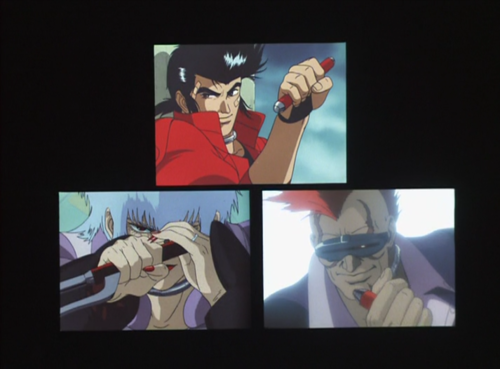
Sillypunk: Cyber City Oedo 808

Last night* I saw a film called Frances Ha. As the first twenty or so minutes of the film passed, I said to myself, "I'm gonna love this movie!" As the movie came to an end, I had no idea whether I loved it anymore. Most of that movie's working parts are hard to discover at first, and it's something that really deserves to be looked at more closely.

Frances Ha, however, does not have a scene where she fights a psychokinetic robot on top of a massive radio tower by punching it in the face. Cyber City Oedo 808, does.


Really, there's not a lot I need to say about it other than that.

Actually, while I love it for its craziness, and as weird as it is to say, there's nothing novel for an anime of it's vintage to be crazy like this, especially one of Kawajiri's. The thing that makes Oedo stand out is that unlike many (or even most) anime of that sort, Oedo is unironically good. Kawajiri has a good eye for imagery and his workmanship is very solid. Some anime from that time are enjoyable despite themselves - because nobody really knew what they were doing and were trying crazy things to make up for their 30,000 dollar budgets - but this is good because Kawajiri can draw from that same well of craziness and has the talent to make it work.

I might be making a mistake by associating it with a lot of those other anime though, because despite the punched-up Manga UK dub, it's actually not nearly as violent or lewd as a lot of its contemporaries, including Kawajiri's other work. While there's certainly blood, and the heroes are criminals, it's actually not that dark. It's not misanthropic, it's not misogynistic, its heroes are likable, and there's never any real risk of the heroes dying. As far as anime of its ilk go, you could almost call it a lighthearted adventure.

One of the things that makes it work is the Manga Entertainment dub. Since this was the period when publishers saw anime's biggest obstacle being the age ghetto, Manga overcompensated by inflating the age rating with added profanity completely absent in the original Japanese script. The result, in this case, is not strictly a good dub, but in a lot of ways it is a good script rewrite. Here's a line from the original Japanese with its subtitle script translation.

「長谷川十蔵、心配すんな。あんたの思う壺にはまってやらあ」// Don't worry Hasegawa, I'm swallowing your bait.
Here's the dub line.
"Okay, okay, I don't wanna buck the trend. I accept your most generous goddam offer."
Now to be fair, the subtitle script doesn't really capture the spirit of the original.「あんたの思う壺にはまってやらあ」is a hell of a lot more brusk than "I'm swallowing your bait," but even so, the English line is just plain better. Even if the dub is ridiculous, it's still by far the most enjoyable way to watch the OVA.

So where does this leave Cyber City Oedo 808 standing?

On a space elevator, fighting robodogs that fire lazors from their maws.

Now if you'll excuse me, I have the sudden urge to read the Cyberpunk 2020 SRD again.

*not actually last night anymore

Tuesday, May 28, 2013

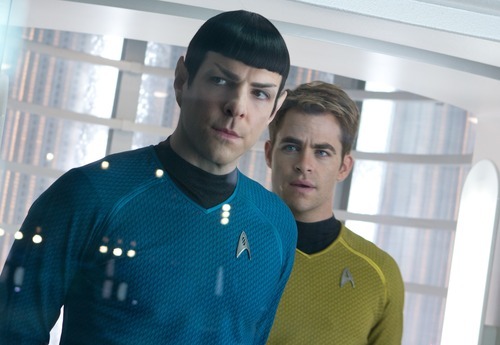
This Is Why I Don't Do Ratings: Star Trek Into Darkness

I am having a very difficult time talking about this movie, because I find myself constantly reassuring people that I actually did enjoy it. It’s true, but maybe you shouldn’t have any reason to believe me, because as I watched the movie, every single observation that occurred to me was negative. I agree with Tarantino when he says “never hate a movie,” but that doesn’t stop me from saying that this movie is actually pretty terrible.

So how do I reconcile all this?


(by the way, there will be spoilers, if you care about those)

The first sequences we get in this movie are of Kirk and McCoy running across a vibrant red landscape. This opening is effective because of the punchy character interaction and flurry of images which give us something interesting to look at every few seconds.

The problem is that this movie never stops running. It never pauses to take even a single breath of air and keeps on running with more or less the same character dynamics, same editing style, and the same cramped framing right up until the end credits. I feel as though the film is yelling “I’m late, I’m late” as it passes by, leaving only a vague impression of a movie.

Khan’s character helps illustrate what I mean. The idea that he’s evil is telegraphed by camera angle and musical cues before the second act even begins. How do we know he’s evil? We don’t even have any idea of what he plans to do from one scene to the next, and the only thing Khan actually does is look intensely into the middle distance. He does nothing else, because the movie doesn’t dwell on any one scene - or even one shot - long enough to give us much information.

Part of this is the writing’s fault. In fact, most of what’s wrong with this film can be found in the script, because while the characters themselves are entertaining, the actual character writing is very, very lazy. I had trouble not giggling in the theatre during the first act while Kirk and Pike basically talked about each others character in the guise of having an argument. It’s easy not to notice it sometimes because the editing and acting is so out-there that you almost don’t notice what anyone is actually saying - as if what they’re actually saying isn’t important.

It’s not that the script doesn’t try to do some interesting things. Kirk and Spock discover some things about how each other face death, and about their characters, and those were some of the strongest moments in the movie for me. They’re interesting thoughts. It’s just that the movie doesn’t seem to have any time to dwell on them before it’s all swept up again in the overall plot, and overall, the script really doesn’t do much with the characters which isn’t strictly required by the plot itself.

On the other hand, maybe I’m not being fair. Star Trek is a latter day tentpole action movie, and when you’re making a film to those specifications, you can either have your characters be complete milquetoasts with guns, or vibrant but very broad. This movie, like The Avengers, goes for the broad approach, and it works. Orci and Kurtzman assembled some good actors, and JJ knew what to do with them. I don’t think any movie ever chooses to have boring characters, but the new Star Trek franchise seems to have chosen not to.

The plot itself, it seems, is concerned largely with connecting its action set pieces in a way that makes sense from moment to moment (and tries to make a statement about the war on terror, because that’s what smart movies do I guess). I don’t ask that a movie have a plot that makes sense, but the problem is that it informs the decisions characters make, and makes things feel inorganic. Characters end up doing things and showing up in places out of convenience and since nobody in the movie seems to notice how weird everything is, it takes a while for it to register with the viewer as well why everything feels like it’s taking place in some kind of weird, lens flare filled dream.

As much as it’s easy to make fun of the lens flare, I do think JJ Abrams can be a good director, but this movie is jarring visually, and it’s not just the editing. Simple sequences of characters walking or talking are shot at weird angles, and there are precious few anchoring shots to be had. Everything is very tight and very dramatic, and it’s all very weird and sometimes disorienting. The action sequences especially fall into the category of films that try to use disorienting montage to convey urgency a la Saving Private Ryan or The Bourne Trilogy without realizing the things that made it work in those films. They’re not exiting, they’re just there.

Some of the film’s most effective imagery is the imagery that it borrows from The Wrath of Khan, which also helps because this is also the point where the movie slows down the most. When Kirk dies a dramatic death after fixing the warp core (by kicking it a lot - I kid you not), the movie actually succeeded in making me feel something. It’s a good moment until the dramatic music starts and the sound fades out. After that, it’s just a matter of waiting until Spock has a fight scene with Khan and they bring Kirk back with Khan’s blood (which is telegraphed rather obviously towards the end of Act 2).

So the one most sincere moment in the film is cheap and kinda manipulative, even if it is effective. That alone is something praiseworthy, I guess. I don’t fault films for being “manipulative,” though on its own, I don’t think it makes a movie. It does not make this movie, in the end.

I guess I can sum up how Star Trek Into Darkness went for me like this: I sat in a theatre for 2 hours while stuff happened and I wasn’t bored but I had no real experience otherwise.

I’ve written far more than I thought I would, and honestly, I could probably write even more about how it shows how filmmaking has changed since 1982 when The Wrath of Khan came out, but maybe I’ll do that another time. After all, it’s been many years since I last saw that movie. Maybe it’s time to revisit it.

Monday, April 22, 2013

Why yes, they do still make 'em like they used to.

I just had an experience.

Or, I had one over the span of the last few days.*

Sit down, and I'll tell you about them: two anime, very unalike, and very unusual. Second for second, both of them have more great stuff going on than most any show you'll have seen this last anime season.

So let's not waste time. Mazinkaiser SKL was released in 2011. But that doesn't matter. Where it comes from, time has no meaning, and Mazinkaiser SKL comes from hell!

Or at the very least, from the anime section from your old Blockbuster video.

I don't feel like I can do this. I am not metal. Only the metal can write about something this metal. Can I handle the power? CAN I HANDLE THE POWER?!

Apparently, director Jun Kawagoe could handle the power. Here's why. Metal is not in the things that the characters ostensively do. Metal is not Loudness singing about the Soldiers of Eternity in the opening credits. If you want your anime to be metal, you have to be able to handle that awesome power. Channel it. Cut it. Arrange it. Put it into order. Jun Kawagoe could have just shown us a slideshow of Mazinkaiser doing cool things, and that wouldn't have been metal.

No, Jun Kawagoe understands Metal, and his sense of editing is perfect. No shot is held too long. No shot is held too short. It has a rhythm. It flows, but it is not languorous. It's not hyper, like the lame double-petal attacks of wannabes like Dragonforce. It's 80s heavy metal drumming. Powerful. Effective.

But editing isn't Metal. Yasujiro Ozu was perhaps the best editor to live, but he wasn't Metal. You know what is Metal though? A giant black robot with a skull cockpit that has fists which are missiles and guns which are axes, and can inexplicably rise from fissures in the ashen earth itself! That's metal. A shot of a giant tornado glowing innerly with untamed power, framed between massive stormclouds, as a giant robot with spike nipples that turn into a polearm shoots through the gap at supersonic speed. That's metal.

You ask, though. You ask, what's it about?

...uhh...

...there's, like, an island where everyone is fighting all the time, and there's a massive energy generator there for no good reason, and it's melting down, and it's going to destroy the world, so Japan sends these two dudes there in a giant robot called Mazinkaiser to fix it. And then they fight a lot. Sometimes they fight alongside some warrior chicks in toga robes with some sort of weird techno-magic. Sometimes they fight alongside this engineer who came to do the actual generator fixing along with some other guys who crash land and die at the start of the movie, and she also has a mech because the commanding officer died and...

You know what? Don't worry about it. The plot makes no goddam sense, and the main characters can be described with little lost nuance as "cold gunslinger, hot-blooded sword guy, and engineer chick," so that's not important. The script is shallow and nonsensical, but at the very least, it's well paced and it isn't overly ridiculous in the harmful sense.

There's a bit of a thematic statement about fate, I think. This movie is very anti-fatalism. So if you want to take away something, that's the thing. Your one thing. Fatalism is lame. Hey, I'm down with that.

Anyway, if you're in the mood for some good 75 minutes worth of entertainment, go find this. Now's the time when I should say, "they really don't make stuff like this anymore." Except they do. They just did. It's called Mazinkaiser SKL.

Changing gears a bit, Little Witch Academia.


You know what's dumb? Representing animation with a still frame. I am loathed to pick a picture to represent what Little Witch Academia is. Luckily for you and me, I don't have to. Trigger, bless their divine animator souls, has uploaded the short in 1080p with English subs on their site. Here it is. Don't take my word for it, go watch it. My words will be here when you're back.

Have you watched it?

Yes? No? Either way, you're here for my thoughts and my thoughts are that Little Witch Academia is really spectacular. It's a labor of animated love in the same way as Redline - an animator's animation. One of the reasons animation became viable as a niche industry is the idea of limited animation: that you don't have to exaggerate models, or try to replicate the fluidity of live action, or have so many moving elements in a scene at a time. You could have still frames and individually animated elements and have it still look OK.

Trigger was having none of that.

See, Little Witch Academia is a contribution to a program called Anime Mirai: a program funded by the Japanese Agency for Cultural Affairs to train and promote the works of new animators (read: help keep the anime industry from dying off because of terrible wages and stressful work). This short is a chance for the new (and old) talent at Trigger to show off all their enthusiasm and talent.

What they made seems to have a foot on both shores. On the one hand, it's easy to say that the super fluid and exaggerated animation style and very closely played magical school tropes make it an homage to American cartoons. It might not even be inaccurate - I'd have to imagine that these guys were watching mid-century Disney in animator's school as much as Miyazaki or Matsumoto.

But this is not a love letter to American cartoons. You can see the anime conceptions of magic in there - the emphasis on bravado and soul. You can definitely see the influence of years of magical girl and moe anime in the characters and setting (all girls, all the time), and in the way they interact. It doesn't feel like almost any other anime I've ever seen, but it still feels like anime.

Don't get the wrong idea. Trigger didn't put this on celluloid because they like drawing cute girls. Trigger put this on celluloid because they like drawing. Certainly, not because they like writing. It would be unfair to call the writing in this short bad. It's not. Some of the banter is quite nice and plays off the animation well. Despite being about as shallow as a koi pond and questionably acted as well, these characters have charisma. All of the other elements are handled competently, and little more.

It is, however, a very trivial anime if you're looking for anything except a light 26 minute visual nosh. However, I must say, if you really are going into something called "Little Witch Academia" looking for Goethe, I question your judgement and sanity as a fellow fan of Japanese cartoons. Little Witch Academia is Shining Chariot: panache and wonder - seemingly shallow and easily dismissed - yet actually deeply important to the continued survival of the anime industry. Anime desperately needs its gene pool mixed up a little.

Seems like our hope for the future just got re-affirmed.


*Actually, weeks. This post got pushed way back. So now I can also recommend to you another Anime Mirai short: Death Billiards. Go check that out too.
Tuesday, February 19, 2013

Cool Cinema in 2012

I think this is my third time re-writing this damnable thing. Be published and gone from my thoughts, vile list!

I originally intended to write a huge thing about film in 2012, but I ran into two problems. First of all, I didn't have the time or motivation to do so. The second problem was that I didn't really see enough films this year to do it with any sort of conviction. I didn't see Holy Motors, I didn't see The Raid: Redemption, and I didn't see The Master, as well as any number of smaller art house films that are probably better pieces of film than almost anything actually on my list, which, when you come down to it, is pretty pop. My excuse is that I'm only really home during the summer, so all I see are summer films.

Given that and since this was a bit of a "yeah, that was decent" sort of year to me, this is a top seven, not top ten. Some runners up were Tinker Tailor Soldier Spy, The Avengers, Argo, Lincoln, and Skyfall.

⑦ Life of Pi
I wasn't going into this film expecting anything great. I expected bromides. I got some of that. It's not as much a film for old white people to feel pan-cultural as I initially feared, but I still do find the milquetoast audience surrogate character to be unneeded and undercutting. I am giving a terrible impression by saying these things right off though, because the rest of the film is so extremely pretty. It is a vibrant film, not just in color, but in the way it uses motion and depth. Ang Lee uses 3d the same way that a lot of American animators use animation. Life of Pi is a film with a great sense for visual space, and that is its main appeal. I do not find Pi's journey especially engaging, or his philosophy interesting, but I like Ebert do appreciate how the film does not "romanticize the tiger." Doing so would ruin the metaphor. Such as it is.

Not Hobbes.

⑥ The Hobbit: An Unexpected 
I don't find it nearly as difficult as I should to put this on my list. It's not a very good film. I might simply be projecting my love and nostalgia for the Lord of the Rings onto The Hobbit, but despite the film being in all honesty a mess, I enjoyed watching this mess. I can diagnose why it's a bad film - it tries to follow the book too closely in structure but makes a half-hearted attempt at making it fit the Hollywood model in terms of characters - but I can't give a general diagnosis for why it still works despite of it. I'd have to tell you about those few vignettes and scenes in the film that hit exactly the right stride and made the rest worth it. I loved how the conversation with the First Age Gang about the Morgul sword played out. I loved the feeling of weight and power the rock giants had. I think the film could have ended on that shot of Erebor in the distance, and I would have been more than happy. The Hobbit does not always hit its stride, but when it does, it hits it quite well.

A hobbit far away from home.
⑤ The Grey
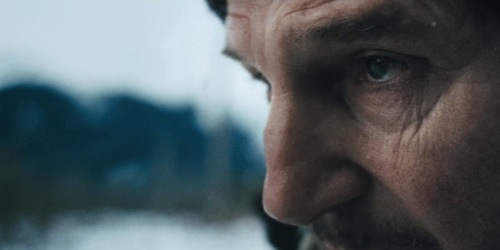
I am not sure why this is up so high on my list. But it is. Maybe I like this film less in retrospect. I'm not sure, but I do know that The Grey gives us something rather uncommon. Liam Neeson's character is badass, but he's a quiet, complicated sort of badass. Middle-aged, working an anonymous job for a faceless company, his skill is made of years of experience. Our protagonist is not emotive, but emotional - he stops short of a suicide attempt within the first few minutes of the film, but he is quietly depressed for relatable, "my wife is dead and I have wasted most of my life" sorts of reasons. Our fellow survivors are equally humanized and characterized in an equally quiet sort of way. Never is the film melodramatic because it's scared it won't get a reaction from us, or that it won't get its point across. Neither is it a work of genius. As I described it above, this film would be Oscar worthy, but parts of it are there in concept but don't work in execution. A lot of the repeated motifs about the guy's wife and childhood are cheesy and dumb and doesn't deserve to be repeated ad-nauseum to us, but I still have a lot of respect for being an action movie that feels so very much unlike a modern action movie.

A wise and complicated badass.
④ Django Unchained
In retrospect, this film suffers just from its having to be compared to Inglorious Basterds. I recognize that as a film, Django might be more important just for its complete evisceration of how the American South is glorified, but I found it lacking in the same charisma that Inglorious Basterds had. Nonetheless, I'm writing this because I enjoyed the film, and it is up very high on my list for a reason. I'm not sure what I should say. Tarantino has a pitch-perfect grasp of visual vocabulary, of how cinema works, and it's not surprising that it's good. Add his own personality to the near flawless technical filmmaking, and I find it difficult to believe that this film could have ever been bad. All the actors give charismatic and entirely non-naturalistic performances (nobody ever thinks for a second that they aren't in a movie, and they don't care), and are super fun to watch, even given the terrible things those characters sometimes do. Standard 20 year old film guy opinion of a Tarantino film: completed.

German dentist + former slave
③ Zero Dark Thirty
I saw Argo. I enjoyed it. Originally, it was on the list, but it got cut due to budgetary restrictions. Also, because I couldn't think of anything interesting to say about it, because when I take a step back and really think about exactly what it was in Argo that I really liked, I found that I was at a bit of a loss. I liked Aflek's 80s hair, I liked how it built suspense, and I liked how it felt fairly mature. Yet, it has that Hollywood soul where I can't quite loose myself in the puppet show because I can see the strings too well.

I don't respect it nearly as much as I do Zero Dark Thirty, which has a soul very much of its own. Zero Dark Thirty is a brave movie. Zero Dark Thirty is not scared that it isn't showing the whole sociopolitical picture, which it feels no real need to show. It is not scared of torture, which it feels no need to address. Zero Dark Thirty cares about a professional woman obsessed with finding Bin Laden, and how she did it. Zero Dark Thirty barely even cares about the character herself. She's directionless once she gets on the C-130 to go back home. Even in the end, the film isn't very intimate with her. It doesn't care if we feel anything - the audience can choose to feel what it will about her ambivalence. Of course, the audience does feel, and it feels quite a lot, because the character is great and the story fascinating. I guess its distance makes it impersonal, but it's never ever cold the same way something like 2001 is cold. The film is just too exiting for that. The third act drops everything to show us the actual operation to kill Bin Laden, and even though this should be a bad choice, it works. Really well.

Maya: CIA agent and hikikomori.

② Moonrise Kingdom
I couldn't care less about two kids and their Newberry-winning coming-of-age story. If Moonrise Kingdom were the sort of book we read in middle school, I would have hated the crap out of it. Books like that feel phony. Something deep in me rejects it like a bad blood transfusion.

Unless, of course, it's by Wes Anderson.

Unlike all those other stories, this film convinced me that the characters have some emotion in them that isn't prescribed by the story. It gives me something to tell me that they're human. Our two kids are seriously troubled, and I love and sympathize with them anyway. No, more than that, I love and sympathise with them because of it. It gives me these completely abnormal, strange, engrossing characters, and then tries to put them through the coming of age formula. When something in the formula doesn't ring true with our characters, it changes the formula. Wes Anderson has made the most quirky and bizarre coming of age film as he could, and he did wonderfully. And naturally given its director, it has an aesthetic to match. Cinema vérité would have only felt hollow. Cinema vérité would have been the death of the film, so it abandons any pretense that anything but the underlying emotions have to be true to life. How boring would it be to shoot a movie like this in by-the-numbers continuity editing? I certainly wouldn't want to make that film.

And, it doesn't forget to have lots of fun either. That's very important. We're all going on a really cool adventure, all things considered, in this whole life thing.

I'm sure they'll find their way.

① Puella Magi Madoka Magica: Beginnings + Eternal
I am a dirty cheating cheater, and here is the test to prove it: I am already in love with the TV anime series of the same name, and these films are not significantly different, so I could have told you these would probably be at the head of the list before I had seen a single other thing. And you know what?

I don't care. I couldn't put anything else as my 1º for cinema in 2012. With all conviction, I hold that these films are important artistically. I acknowledge that they're untenable for a wide audience because of the artifacts of an insular anime industry, and I acknowledge that they have structural flaws that would damage any normal film, but neither of those things are significant.

All that matters is that these two movies are absolutely beautiful Every aspect of the design from the bottom up paints a whole of incredible atmosphere and intricate thematic detail. I find an almost Kubrick-like level of attentiveness and stylistic fingerprint. Magical girls in magical girl anime often fight witches, but never the things that we see here. When we see the enemy, they are profane and arcane and poetic. It all comes together in the form of a script which gives us heartfelt and dynamic characters, and maps out the course by which they will be deconstructed noble intention by noble intention until they lay a broken mess. Only then are they put back together again a shining new whole. Yuki Kajiura composes an eerie, sometimes dramatic, sometimes serene, always very, very memorable score to accompany.

These movies are in equal parts deconstruction and reconstruction. They are cruel and terrible movies about loneliness, uncertainty, despair, and entropy. It rejects self-sacrifice, it rejects egoism, and in the end, even love is uncertain. Yet in the end, it rejects despair too - and embraces hope. Not through any of the trite and bromidic ways we have come to expect - Madoka Magica earns the right to have the message it does, and earns it well and hard. I recall few things that were ever so simultaneously cohesive and compelling.

I have few pieces of media I like as much as these films. I can never be certain who is capable of getting the most out of anime and who isn't, but if you appreciate good film and are open to occasional moments of inexplicable weirdness, I cannot recommend these films enough.


IN SPES CREDEMUS. IN MADOKA CONFIDAMUS.

Wednesday, January 9, 2013

Comiket 83 - Music and Stuff

I really don't feel like trying to copy everything over and fix the formatting for the stuff I wrote about albums from this recent Comiket, especially since I'm not quite done. I'm pretty sure what few readers I have tl;dr that stuff anyway. I'll just post links for now.

冬コミ - Comiket Cometh Anon

C83#01: Dominated Dancehall - Alstroemeria Records

C83#02: Double Key - Zytokine

C83#03: チェス - 豚乙女

C83#04: Mágico Catástrofe - ShibayanRecords

Also, Airfoil E.P. is awesome and you should go find that too.


Coming soon: favorite films of 2012? It's more likely than you think.

Tuesday, November 27, 2012

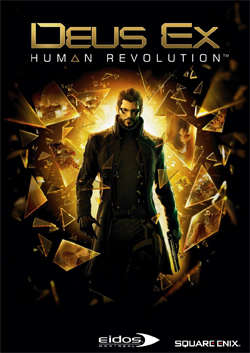
Deus Ex: Human Resources

Also from my tumblr, a ramble-y thing that really should have gotten edited, but I'm not going to bother doing so even now.

So, a bit more than a week ago, I went down to gamestop to buy Halo 4. I’ve been a fan of Halo for quite some time, but you couldn’t actually call me a long time fan, even though that’s what it feels like. I remember very clearly, in eighth grade, before my parents actually allowed me to play them, Halo and its story was the shit. One of my friends told me the story up until that point (this was before Halo 3 came out) in installments during art class, and he told it well. I was captivated. This was really one of my first exposures to a lot of the pop culture tropes that contemporary gamers would have found common.

Since then, I’ve moved out into the gaming world, but I still defend Halo as still being perhaps the best multiplayer shooter franchise out there, even though the rest of the world either plays CoD and thinks Halo is for nerds, or plays TF2 and thinks Halo is for CoD kiddies. And honestly, TF2 is probably the better online multiplayer shooter, and certainly a lot of the audience Halo previously had locked has moved on to CoD.

So I went down to gamestop to buy Halo 4, but I wasn’t as exited as I might have been. I arrived, and gave the used games a look over while I was there, and one caught my eye. Deus Ex: Human Revolution. I had heard great things about this game, and it was only 17 dollars. This, I figured, was an excellent deal. What of Halo 4? I figured I’d buy it later. Deus Ex was cheaper, and probably a better game. So I walked out of there with Deus Ex instead.

And now, just recently, I beat it.

This is old news by now, I expect. People know about how cool the setting is, how smart the writing is, how dumb the boss fights and third act are, and all that. I agree with most of the common consensus, though I honestly did enjoy the fight against Federova, but by that point I had dermal and leg augs, which helped tremendously by allowing me to bunny hop and machinepistol my way to victory.

And I imagine that people are also pretty tired about hearing how interesting the commentary on transhumanism is. If I wanted to weigh in on this fully, I’d devote a whole post to it, and it’d go something like this. There is no real higher level ethical debate to be had about transhumanism. If you want to establish that it compromises your humanity, and therefore you shouldn’t do it, you must first establish two things. You must establish that humanity requires having flesh and blood and lacking these causes the rest to be irrelevant, and you must establish that this conception of humanity is in and of itself ethically valuable. Both of these are highly problematic, and I have trouble coming up with an answer to either that does not veer off into magical thinking.

Fortunately, Deus Ex HR Department does not focus so much on that. It at the same time acknowledges these feelings, creates characters with whom you may sympathise about, but at the same time, it does not force that particular issue. It’s used in a far more interesting way in a very memorable conversation with an injured and dying anti-augmentation detective you meet some way through the game.

Instead, Deus Ex HR focuses on the practical upshot of transhumanism: it costs money. Augmentation isgreat for those who can afford it and can also afford the neuropozyne to avoid rejection symptoms. But it deepens the disparity between rich and poor. Humans can still compete with transhumans for now, but the bar is getting steeper and steeper. Ignoring the social problems is difficult even for those who would normally not see it as a problem at all, as it’s possible society itself may not survive long enough for augmentation to become so cheap and practical that, as Edison put it, “only the rich will burn candles.”

And really, ethics does not concern itself nearly enough with road tests. In the traditional thought experiments, outcomes are epistemologically certain, always. If you don’t flip this switch, five people will get run over by the murdertrain. If you do, you will kill a man on a different rail, even if you yell at him to run. But few things in the real world are so certain.

This is why Deus Ex makes such an interesting case. You can augment humanity, make yourselves gods, but if you try, the world could easily destroy itself before that happens. You could regulate augmentations, but then you’d be regulating the human body itself. If you leave it unregulated, it may not change human nature, but it turns potential tragedies into potential nightmares. The consequences of your actions are amplified along with your abilities. Augmentation changes the premises.

For instance, in Deus Ex, you routinely come into situations where you are under fire and can justifiably call any killing you do as in self-defense. It’s an intuitive response. But you are playing as Adam Jensen, a transhuman man of the future, who can just as easily knock a guard out cold as stab him with an arm blade. Given that, is Adam in any way remiss for killing a guard in defense instead of simply subduing him, where otherwise, he might be perfectly justified in murder? Where is the threshold between feasibility of non-lethality and the justification of lethal force?

I think it’s difficult to ascertain any moral weight of the distinction (I’m actually not sure if moral weight should look quite how it does in modern ethics), but it seems to me that Adam, if he acts rationally, should prefer non-lethality.

But whatever. Adam has retractable sunglasses implanted in his skull, and that automatically justifies anything he does.
So yeah, Deus Ex Human Revolution is a really cool air vent crawling simulator, and y’all should play it if you haven’t already. The characters are very well written, the gameplay is solid, and the atmosphere is great.

Almost German Expressionism - The Romance Novel

Posting your thoughts on someone else's work immediately after posting some of your own is probably in bad form, but oh well.  I'm not claiming I'm any better or worse or anything.  Just a disclaimer.

I don't read nearly as much as I want to anymore. I suppose it's just a matter of priorities, but it's still rather unfortunate. Most of what I read I actually listen to on audio book traveling to and from college in the car.

Recently, I just finished a book by Erin Morgenstern called The Night Circus. Now, if I didn't know better, I'd guess that Erin Morgenstern were a pen-name. I mean, how awesome is it to have the last name "blackstar?" Erin Blackstar. German is an awesome language, isn't it? Damn recht es ist.

The story itself is a romance framed by a contest between the disciples of two magicians, who are out to answer the question of whether sorcerers or wizards are stronger once and for all.

Of course, the story has nothing to do with D&D, but the two magicians certainly lie on that dichotomy. Marco is the wizard, and his reliance on spellbooks (not in the traditional sense, mind you) and power sources gives him a large amount of control and autonomy, but little at-will power. Celia is the sorcerer, her power limited on the upper bound by raw force of will, and on the lower bound by self-control and self-knowledge.

Inevitably, they fall in a nominally all-consuming love, and inevitably, the plot comes in between them and happiness. I have no deep and abiding love for romance novels, but I appreciate the well done ones, and the Night Circus, hypothetically, has some interesting things going for it.

For one, I am a huge fan of stories that use magic thematically rather than solely as plot propellant or setting window dressing. Magic in this world is complicated and makes it much easier to make serious mistakes. It is a constant drain on both contestants to maintain the circus. At least, we're told this, but I don't think either of these points are ever driven home, even if the plot elements are there. The one time when magic amplifies ordinary drama beyond its normal scope, when the novel actually demonstrates how easy it is to mess up with magic, it feels very much like douche ex machina. We never are given a decent explanation for why a certain character incites another to go murder a certain other one. It's just something that happens.

And really, that explains a lot about how the characters act in this novel. For main characters who carry literal scars with them from their past, they've got themselves very much together, and aren't seen really doing anything that isn't required explicitly by the plot. You'd think they'd be full of wonderfully interesting quirks and insecurities and motivations beyond the challenge, but they really don't. There is extraordinarily little character drama going on here. It's just them versus the plot, and the plot inevitably wins.

All of this ends up with an author filibuster as delivered through a one-sided conversation between A.H. and Widge (not the Cyberchase character...oh god, why do I even still remember that show?). I really wish Widge had provided a more contrasting point of view in that tract. That would have made it a lot stronger, I think. As is, the story doesn't really have much in the way of commentary on anything except the context this final conversation gives, but what was there wasn't...bad...per se, but it was a bit hollow, and along with the unsatisfying love story with the unsatisfying characters, this only leaves the story one leg to stand on.

The writing itself.

Which is pretty awesome. It maintains atmosphere extraordinarily well. The surrealism of the circus is handled quite well, even if it does seem a tad obsessed with the smell of caramel (is it a metaphor or something?). The story is structured in a non-linear fashion that at first seems unnecessary but eventually becomes understandable as a creative choice. The world-building is convincing and sets a very interesting stage that deserved an equally interesting cast. I would love to see another story, written with these same premises, in this same narrative voice. I hope Ms. Morgenstern (power metal riff here) revisits this world at some point, maybe in a short story.

So I guess my overall reaction is that this isn't a really bad story. It's not, even if I'm critical of it. I'm critical of it because of how much better it could have been. I did enjoy listening to it very much, and I suppose I can still give it some sort of recommendation, just on account of its writing style. I just wish it did something more.