I'm also going to try to stop being so very formulaic in the way I go about talking about these albums. Music is probably the most subjective sort of art, and it's not something one can so much review as it is something one writes about, analyzing and voicing opinions, but not necessarily judging as good or bad in an objective sense. Usually, this sort of idea is a sell-out, and if I didn't voice any opinion whatsoever, it would be, but I aim to be interesting: a few hundred words rattling off which songs are pretty good and which ones have problems is boring, boring, horribly boring. Touhou is not a boring series of games, and the sort of music that has come out of C81 isn't boring either.
じゃ、はじめましょうね!
Avidya
 |
Yukari is totally Buddhist: she's
too lazy to have desires.
|
And what's less boring than going in alphabetical order? Nothing, bro: alphabetical order is totally rad, and you know what, so is Avidya. This is a joint production between Syrufit and *Poplica. I've already heard quite a bit of Syrufit, both on Alstroemeria Records albums and on his own, under the name Syrup Comfiture. His tracks may sometimes seem to lack Minoshima's diversity in style, but he's also more consistently good, and as I mentioned once before, he's a heck of a lot better at picking and arranging for vocalists. *Poplica, on the other hand, I've heard very little of, but what I have heard has been pretty good. Syrufit and *Poplica are not new to collaborations: they've actually produced quite a number of albums together before. After hearing this album, I'll have to look up some more. They have different styles, but they compliment each other quite well.
Anyway, Avidya sets the atmosphere with ambient Shakuhachi and electro in a very distinct, Syrufit sort of manner. It's an original track, so the fact that Syrufit's style comes through strongly here...is not a surprise. Another Vision carries this on the electro side of things, also a Syrufit track, though this one perhaps too repetitive and atmospheric for its own good. I'm not quite what's going on with the vocal samples, and I don't think it quite worked out how Syrufit might have wanted it to. *Poplica's first track on the album is We Are (I haven't the faintest). The style is distinctly more built around distinct synth chordal progressions, or in other words, more like Alstroemeria style progressive house and, well, more pop-ish sounds. As a matter of fact, it feels a bit like eurodance in structure, but with a certain air of maturity to it that most eurodance doesn't really have. Rapture continues more along that stylistic line, but reversed, with the vocals forming the melody with atmospheric synth and piano work and house style 4/4 beat providing a mild counter-point. It's almost more Syrufit style-wise than *poplica. et Cetera is actually Linjin's work, but it fits with the album's flow well. I quite like the very rapid, distinctly stress-metered vocals, even if at its core, it's a rather simple track, with continuo synths and fairly standard percussion work. Perhaps it goes to show that the tropes wouldn't be so tired if people would just put some soul and talent into them. Links is also a combo-breaker in that it is a co-arrangement by Syrufit and *Poplica. I'm immediately suspicious when more than one person begins working on a single track, and to be honest, I don't think this is as good as any of the tracks they worked on individually, but it does retain the soul of the album. *Poplica and Syrufit work very well together, it seems. I will say this though: I'm not sure what modulator they put the vocals through, but it sounds a little like Miku Hatsune. Confirming my theory that Syrufit and *Poplica work well as a team, Stellar is a very heavily phrased sort of upbeat house track with a very strong central feeling. It's pretty stellar. Anyway, it's Röyskopp's turn for Candle, the next track on...wait, Röyskopp? No, this is definitely Syrufit. Huh, coulda sworn it was Röyskopp, what with the very low base+pad aesthetic it opens with...and the quiet, mid-octave range vocals it continues with...and ends with. It's undeniably Syrufit in its structure, and it fits with the rest of the album, but it's still kinda uncanny. You know what doesn't fit at all with the rest of the album though? Innocent - Nhato remix. 2/2 beat, base drops, noisy/growly instrumental interludes, yep, this is Touhou dubstep. It actually works pretty well, for dubstep. The clear sounding, airy interpretation of Broken Moon that the base-dropping segments play off of make it, I think. The last track, Angel's Doubt - a very vague sort of interpretation of Necrofantasia - actually uses dubstep style tropes in concert with the atmospheric style synths we've come to expect from Syrufit/Poplica extraordinarily well, proving that dubstep might have actually given us an interesting musical tool, if people would only stop making the same song over and over again already.
I don't really have as much to say about Avidya as I do about, say, Killed Dancehall, not because it's not good, but because it didn't evoke much more of a reaction than pure enjoyment. I'm certainly not saying it's only mediocre, because it's actually a very good album that I recommend any electronic music fan listen to, but that said, it didn't inspire much passion in me either. But with a Buddhist name like Avidya, perhaps passion isn't what this album was really about.
Lol, the bs I say sometimes. Go listen to this album. No really.
Begierde des Zauberer
 |
| Marisa took a trip to Mordor, naturally intending to steal Sauron's ring. |
Apparently, it was really good timing that I only just discovered Demetori, because I didn't have to wait as long for their next album, which came out this Comiket after a rather lengthy period of time when they didn't produce anything. What they did eventually release was Begierde des Zauberer - The Magician's Longing in German, referring to Marisa Kirisame: the Lord Byron of Gensokyo. I guess Patchouli would be Anne Isabella, in that case. Who would Alice be though... Agh, muisc, yes, topic.
The introductory track is most appropriately named "introduction," and serves as an introduction. Derp. The dark synths build into the introduction of the guitars and twisted version of what I think of as the "ZUN scale progression" that always appears in his menu themes, and it's all very badass. What's surprising is that, even though they share very similar riffs in the start, albeit in different keys, it doesn't transition into the next track like an Alstroemeria album might, which actually makes the similarity sound rather awkward. In fact, the first few bars of Plastic Mind ~ Alice in Underground are actually rather awkward, with a very straight speed metal beat, but it straightens itself out quite nicely into Demetori's signature guitar and synth double counterpoint. It never quite feels like the brothers' A game because of some weirdness with the percussion and synth in one part of the bridge, but flawed as it may be, it is also quite awesome. Rigid Paradise ~ Dawn of the Dead is also awesomeness, great simply in general, but notable for how well it manages to make the "Dawn of the Dead" part of its name work, with some very nice use of atmosphere in what could have easily been a very straight progressive metal track. Love Colored Master Spark ~ Final Sorcery takes Marisa's already very rock-like theme and puts it through Demetori's metal filter. The result follows the original quite closely, feeling very much like a Demetori version of a ZUN track rather than a Demetori track that happens to use a riff from ZUN somewhere. I can't fault Demetori for this, because I certainly don't think they have anything to prove, but also because they do such a great job of maintaining and reinforcing the soul of the tomboyish, cocky, rainbow-colored-destruction wielding mage and kleptomaniac named Marisa. Perhaps fittingly, U.N. Owen Was Her follows this, matches it, and crushes it in the palm of its hand while grinning madly. I didn't like this track as much when I first listened to it, but the more I do, the more I realize what a great job of keeping the eerie power of the original whilst at the same time totally twisting it into something eldritch and heady with Flandre's insane spirit. U.N. Owen is a very hard composition to work with, but Demetori rises to the challenge quite beautifully, which may be one of the reasons for it being one of the most memorable tracks on the album. Magus Night ~ Frenzy Night seems rather tame and straightforward in comparison, and it actually is rather straight forward for a Demetori track. Which is not to say it's bad. The song it's nominally an arrangement of is from Fairy Wars, and yet occasionally, I seem to hear quotes from other ZUN songs, especially Doll Judgement, but I suppose that comes with the territory of being from ZUN. Really, this album's problem is that too much of it sounds like Demetori playing ZUN, which, while awesome, can get a bit tiring. Desire Drive ~ Desire Dream is not an exception to this, being exactly that: Demetori's version of Desire Drive. I can't really substantiate specifically why this is, but on the other hand, I don't particularly care, because as I said before, Demetori playing ZUN is still oh so very awesome. Endless ~ The Endless Deadly Deadly Sins provides a nice buffer before the final track, Strawberry Crisis !!!!!! It's very speedy and adroitly played with the flare one expects from Demetori, but I think the guitar work stands out here even in comparison with the other tracks on the album.
As a whole, it's not as interesting as Nada Upasana Pundarika, or as varied or clever, but given how brilliant Nada Upasana Pundarika was, that's a rather unreasonable bar to set. I definitely recommend anyone who likes hard rock or metal give it a listen, but after Nada Upasana Pundarika. I also have to say that, though I have not listened to any others in their entirety, it's probably their second best album, so take that for whatever it's worth.
Killed Dancehall
 |
| Geez Flandre, this is the fifth Dancehall you've killed this year! |
I think I've said it before, but Alstroemeria Records is really, really unreliable sometimes. You never know whether you're going to get good Minoshima or evil Minoshima. When I first listened to this album, I knew it was good Minoshima, but I couldn't make up my mind how good. While it's not really brilliant in the same way as Haunted Dancehall was, the more I listen to it, the more I like it, and the more I think that it's a very good mirror of its predecessor. See, Haunted Dancehall was etherial and full of groovy, almost disco-esque soul. It was "haunted," as if spirits were floating around in the data. Killed Dancehall is much more hard-edged, taking the structure and spirit of the original and going for a much more electronic feel. Killed Dancehall is to Haunted Dancehall as Human After All was to Discovery: not as good, but a very interesting mirror, and still, in the end, a pretty neat album.
I shouldn't even need to mention that it starts with a short original track with sampled vocals that leads into a longer track, but I should mention that this one - Undercover - is especially cool. What it leads into, Romantic Children, lives up to this promising intro, at least partially. The pulsing synth echoes the soul of Haunted Dancehall, and yet, in it, there is a depth: something hard and unyielding. Unfortunately, Minoshima being Minoshima, he writes a vocal part for Nachi Sakue (whose name I've been improperly romanizing as Nachi Sakagami for the longest time, ごめんなさい) which falls into the common trap of being high and "moe" in a track where it's really not appropriate, and it doesn't really work. On a track where everything else works so well, it's quite unfortunate. Luckily, there's a vaguely Daft Punk-esque bridge into a track with Mei Ayakura vocals: Unknown. There are still traces of the intro track as it begins, actually. The arrangement is is very Minoshima in several ways. The interplay between the instruments and the vocals is minimal, but contributes to an overall whole very well. It's also supposedly an arrange of U.N. Owen, but in true fashion, the only part of U.N. Owen Minoshima actually seems to have used is the continuo part. It's probably the best track on the album, actually. It's followed by Phantoms in da House by Nhato. He's always a bit of a gamble, but this track is actually very interesting, and very distinctly his style. It uses the melody of Phantom Ensemble in some rather interesting ways, along with a very wide range of hard-edged electronic instrumentation, used playfully and in very good harmony. I think I also hear the pentatonic scale progression from Ancient Temple at one point, but I could just be hearing things. Brazil follows, which is a very strange Minoshima original, with a totally incomprehensible vocal sample (I'm not entirely sure what language it is, even) used in concert (though not really harmony) with the sort of instrumental backing one expects from Minoshima. It's disappointing for an original track to be as uninteresting as all that, but it's over about four minutes and goes on to Lunar DIAL, another rather odd track with a riff that uses glissando to...some effect anyway. To be honest, I'm really not certain at all about the reasoning behind some of the stuff in this track, like the rhythmic, compressed vocal segments, but it nonetheless works fairly well, even if it's confusing. Endless is confusing for different reasons. Minoshima bases this track partially on an English DJ track, with the refrain "My fellas run this muthafucka." Oh Minoshima. One of these days I'll go to Comiket myself and ask you where you keep finding these samples. Musically, it actually works really well, and ends up being a really fun track, with a tight sense of rhythm and tone. It marks the transition from the album's rather mediocre middle to its strong end, a trend that continues with Flowering Night, a track that plays with the riff from, guess what, Flowering Night, and continues on into what might have actually sounded more at home on Haunted Dancehall (or, for that matter, Harmony), with its piano and laid back vocal aesthetic. It flows into Underdog, the other Minoshima original on the album, and by far the better one. It's his often-used double layered style, with a complicated looped undercurrent and much more broad melody section for some sort of glissando-y FM synth. It's pretty neat. The album proper ends with Underdog, but Syrufit contributes an extra track at the end called DIS_K. It's rather uncharacteristic of Syrufit, and I checked twice to make sure I had read it right and it was in fact Syrufit, because it's much more in a glitch sort of style than really anything else he's done that I can recall. It's good to have heard him try something new, but I can't say I like glitch-mode Syrufit as much.
Killed Dancehall starts off very strongly, has a mediocre middle, but then picks up again quite nicely for the end. After Haunted Dancehall, I was expecting a bit more, but all things considered, this is still probably one of Alstroemeria Records' better albums, at least as good as Fragment Reactions, and probably on par with Plastik World. Yet, I don't feel quite right comparing it with something like Plastik World, because Alstroemeria Records has changed so much from that era. Bad Apple!! barely even feels like it came from the same artist. Minoshima is going in a new direction, I think the two Dancehall albums have shown that pretty clearly. What will be next, I wonder. Fused Dancehall, maybe? I think Utsuho has only been on the cover once, and that was Double Counterpoint...so what I really meant to say was "Utsuho has never been on an Alstroemeria Records cover, what are you talking about?"
Uncanny Instinct
Being arrangements of somebody else's already brilliant work, one can't help but be slightly cynical about the actual talent of some doujin arrangers. While some may produce decent covers, I don't think all of them would be as good if they played completely original material. This is only to be expected, but on the other hand, it does take a considerable amount of talent to create truly great arrangements, talent that would easily be applicable to original material. The best doujin circles would no doubt be notable if they did play their own material, and in fact, many do put completely or almost completely original tracks on their albums. Alstroemeria Records does this all the time, either with totally original material or only using elements from the original totally out of context for different ends. Though Minoshima, Syrufit, and Nhato often play sets as club DJs (under the name Badcats Party), surprisingly none of them have released original albums. EastNewSound, however, has, and their product is Uncanny Instinct. I wish I were more familiar with EastNewSound beforehand to see how much of the style here is present in their Touhou arrangements, but that said, what I have heard has been very interesting. For refrence, possibly their most known piece being a really great U.N. Owen arrangement called...(looks up kanji)...crap...Under a Scarlet Moon, Absolute Insanity...I hope. あなたが甘い...甘い...赤い...赤い...フフ殺してあげる!
Looking at the track information, I think the defining feature of this album is that it has so many different artists contributing to it, yet I think you can still pretty definitively call the album electronica. We start the album with Summer Breeze. The translation on touhouwiki says "Summer Wind," and this isn't really inaccurate, but it sounds weird, and in my world, I'd like to think that Kofun P is a Seals & Croft fan. The song itself is a melodic affair with moe vocals that, fortunately, are arranged and performed well enough not to be grating. The easy listening synth provides a sugary second layer of melody that provides harmony with the vocals occasionally, but doesn't really do much else. It's really pretty bland stuff, but it's inoffensive, and afterwards, Steel Cliff comes along and takes it in a more eurodance-y direction. It would sound a little bit like Harmony-era Minoshima were the vocals not so chromatic and in a tolerable octave. It's got some nice harmonies with the base part and percussive piano, and works quite admirably. While the arranger was different, the vocalist was actually the same as the first track. Whaddaya know, I guess it's just Minoshima who can't pick good vocalists. The next track, In a Constant World (again, not the touhouwiki translation, but heck, even GoogleTranslate says that 「変わらぬ」 means "constant") is more glitchy in its instrumentation, but despite being from a different composer, is structurally similar to the previous track. Its vocals are of the "low and breathy" sort, another one of those aesthetics I can never quite get into, but I suppose they are interwoven with the instrumentation fairly well. Original Remind (this one was named in English originally, can't you tell) comes next and keeps up with the trance-like trend of the last two tracks, with meandering vocals, very lightly phrased vocals, and high-attack synth and pad second layer. It's really quite traditional, but it does its thing well, and moves on to EasyNaturalStep. Now, EasyNaturalStep is probably one of the most Jpop-like tracks on the album, but it's also probably my favorite. It has a very well done vocal section, trading off between heavily phrased and harmonized female vocals and rapid rap sections, playing off of the admittedly pretty simple major-key continuo and base. It helps that this is one of those lucky tracks where I can sorta-kinda understand the lyrics...well, one half of the lyrics anyway. It has this pervasive atmosphere of fun that good pop should have, with the adroit execution and soul to make it work. I'd call it a guilty pleasure, but I can't say I feel all that guilty. Within the Light follows this up, a more slow paced track with a simpler sort of melody, going for a softer feel, with its soft-spoken (not breathy, mind you) vocals, percussive piano, and pad aesthetic. As this is the same composer as In a Constant World, this isn't particularly surprising. Again though, I can't honestly say it doesn't work, but it does go on into The Two of Us, which is another one of the album's more notable tracks, also by Kurotori (Black Swan), the composer of EasyNaturalStep and Under a Scarlet Moon, Absolute Insanity. It's got a very interesting minor-key vocal section and some very good use of distortion and pads in its instrumental and continuo section. It at times feels the slightest bit like Yuki Kajiura, actually. I think it's the sweeping and rather un-pop-like melody and solo section, but it's more likely I'm simply hearing things. Monochrome, sorry Monokuroumu, is next, and it maintains the quality of the previous track. Again though, I'm having trouble pinning down exactly why this is. It's not a melody with traditionally constructed tonalities, anyway, so maybe I like it just because it sounds different. The next song is Paper Planes (which was hilariously mis-romanized in the download I got ahold of as "kamihiko uki" instead of "kami hikouki," but I suppose I should be glad he didn't translate it as "Spirit Plane" or something) is the third song on the album from Kurotori, but it's also probably my least favorite, despite the fact that his style continues to remind me of Yuki Kajiura for some incomprehensible and probably really stupid reason. Maybe I just don't like the fact that he opted for very traditional trance-style synth instrumentation this time. Before the Dawn Breaks finishes the album on a rather Jpop-y note, but an exceptionally good Jpop-y note. Actually, many Jpop-y notes in a row. That together form a song. Sorry, sorry, anyway, the pulsing synth and continuo harmonize with the vocals quite well, and give the song a distinct aesthetic despite it's questionable heritage.
Uncanny Instinct is a good album, and I think I could point to it as proof that doujin circles aren't worthless second-handers and actually do have some genuine talent. I would not call this one of my favorite albums ever, not by a long shot, but I see myself listening to it quite a bit in the future. I think EastNewSound could make quite a name for themselves as an indie music group, though if they do want to make their way in the world, I'm not sure if they want to stick with the anime lesbian album covers. I love anime, and I love lesbians, but really, they're not doing themselves any favors. I'm also a little confused, because I'm looking through their discography on touhouwiki, and as far as I can tell, despite Touhou being responsible for a good 75% of the world's girl-love manga and fanart, this is their first album cover to do this.
Why am I spending so much time talking about this?
Edit: I looked it up, and apparently "Under a Scarlet Moon, Absolute Insanity" is actually, according to touhouwiki anyway, "Beneath the Scarlet Moon, The Crazed Blossoms' Severance." Got the first part right, but not so much the second.
-----------------------------------------whyistherenohorizontalrulefunction-----------------------------------------
Touhou Pianoforte I - Requiem for Sakura
I'm actually going to cheat a little and talk about an album that is actually from...you know, I'm actually not sure, because it's not on touhouwiki at all. *looks up* Apparently, this was C79, so only a year ago or so. The artist - Tomoya-san - is on youtube here. He's pretty small-time, and as a result, the quality of the recording is pretty awful. There's significant cut-off at the high end that causes some really unfortunate distortion. Fortunately, the music itself is beautiful. A piano album like this isn't the same thing as a more traditional doujin arrangement, because it's usually much more straightforward in its interpretations of the originals. For this reason, I think it'd be more accurate to call this "variations on ZUN" instead of "arrangements of ZUN." "Variations" sounds higher-brow anyway.
Unfortunately, I can find only two tracks from this album on youtube, both uploaded by kkcwkoh. I'll go ahead and say that it's worth downloading, or, if you live in Japan and are actually able to buy it, buying.
Because of its nature as piano variations on Touhou music, mostly from Perfect Cherry Blossom, I'm afraid I don't have as much to talk about. It opens with the "ZUN scale progression," naturally, but moves on to, actually, a rather powerful motif on Sakura, Sakura, which is fitting with the whole "Perfect Cherry Blossom" thing, and also thematically, since contrary to popular belief, the song was only popularized in its modern form in the Meiji period (though the melody was from Edo), when Japan was modernizing, and the romanticization of its history began. This is the era that Gensokyo appears to be in technologically as well. All this weaves in quite well with a variation on Ancient Temple, one of ZUN's more under-recognized compositions, played with feeling and flare. Next is a very dizzy, formless, yet still strong variation on Mystic Dream. After this is a variation on Hiroari Shoots a Strange Bird (another one of Youmu's themes), this time much stronger in its central themes. It captures the feel of the original better than the original did, in some ways. The Sakura, Sakura motif returns in the next track, which is a variation on Ultimate Truth. It doesn't feel as strong as some of the other tracks on the album, but as a relative measure, this is meaningless, since the rest of the album is so awesome. A variation on The Doll Maker of Bucharesti is next. Alice's themes are some of my favorites from PCB, and this track is one of the best on the album. Next is a variation on Paradise, a track I'm actually not as familiar with. However, the arrangement itself is very nice, and played with the characteristic flare. I'm even less familiar with the next track, Prayer in Service of the Sky ~ Towards Equal Heights, mainly because it's not actually from Touhou, but Clannad, an anime. I've never seen Clannad, but it has quite a large fandom. I imagine that if I saw it, I'd like, but it is, at its core, a soap-opera, so I'm not sure if I could ever take myself seriously again. Then again, I loved every panel of Touhou Tonari, so I guess I already kinda can't take myself seriously. Anyway, the track is good, and even though it's quite obviously not ZUN's style, it's still Tomoya-san's, so it's all good. Next, going apparently in reverse order, is a very nice variation on The Fantastic Tale of Touno. The album concludes with a variation on Phantom Ensemble, a very nice end to the album, embodying quite a few of the themes present throughout.
It's an extraordinary album, carrying the atmosphere of PCB's soundtrack perfectly, except for the recording hiccups. It's probably my favorite Touhou piano album. I once played this album for a friend of mine who listens to almost nothing but top 40 stations and has been exposed to very, very little Japanese otaku culture, and he said he very much enjoyed it. If that's not an endorsement, I don't really know what is.
Symphonic Suite: Embodiment of the Scarlet Devil
If only, if only. The more I think about it, the more I think how perfectly Touhou soundtracks are structured to be adapted into symphonic suites. Think Pictures at an Exhibition. Think about it: every Touhou soundtrack has a very proper first segment - the menu music - to set the theme. Each is already segmented into very distinct sections that explore their own themes, but progress the suite as a whole. ZUN's work, if handled correctly, could be played very well by even a small orchestra or septette and piano. It wouldn't be overly long (about the same length as your average symphony), and would be a unique experience even for people who are already familiar with video game music.
In my ideal world, someone would get ZUN's permission (or heck, maybe even inspire ZUN to do it himself, the lazy drunk) to write a symphonic suite based on Embodiment of the Scarlet Devil. Since Touhou fandom is rather large in Japan, I think someone could conceivably convince even the Tokyo Philharmonic to do it. Hey, they've done Final Fantasy, though granted, Nobuo Uematsu is a respected name in higher circles, and Junnya Ota really isn't. If it's a success, then there are still seven more games to do, not to mention all the spin-off games ZUN has composed music for.
If I were to undertake the task of adapting ZUN for orchestra, a task I'm in no way qualified to do, despite the meaningless jargon I throw around, I'd try to keep a few things in mind. First, while Touhou compositions work because of melody, the also work because of their unique atmospheres, so having the whole string section playing the same part simply won't do. Any Touhou orchestration has to emphasize solo performances and interplay, perhaps using instrument combinations not often seen in more traditional video game arrangements. TAMusic has demonstrated that simple violin and piano can go a long way. Too many have forgotten that large orchestras originally evolved for variety and flavor, not for redoubling the same handful of sounds. Speaking of which, I also imagine that, if at all possible, a clavichord would be most useful to the orchestra. I should also think that choruses should be spared for the most part. There are few tracks that I think would really benefit from that sort of aesthetic, but on the other hand, using them for the tracks that are already supposed to be bombastic, like U.N. Owen Was Her, might work. The trope became popular for a very good reason, it's just that people keep on using it without understanding what makes it work.
One Winged Vampire. Lol.
Anyway, I'm thinking the chances of this happening are very much dependent on what mood ZUN is in, and knowing ZUN, that means it's pretty darn unlikely, but one can hope. Perhaps we'll continue to see things like the performance in the video above. This isn't what I had in mind, stylistically or otherwise, but having anything Touhou played by an actual orchestra is pretty darn cool.
On the other hand, maybe all we need is a good ol' tavern bard.
 |
Blonde: Woe! My soliloquies be verily poor:
I must anon resolve to further my emoting!
Purple: Oh man, the salt on your skin is making
me soooo high~
|
Looking at the track information, I think the defining feature of this album is that it has so many different artists contributing to it, yet I think you can still pretty definitively call the album electronica. We start the album with Summer Breeze. The translation on touhouwiki says "Summer Wind," and this isn't really inaccurate, but it sounds weird, and in my world, I'd like to think that Kofun P is a Seals & Croft fan. The song itself is a melodic affair with moe vocals that, fortunately, are arranged and performed well enough not to be grating. The easy listening synth provides a sugary second layer of melody that provides harmony with the vocals occasionally, but doesn't really do much else. It's really pretty bland stuff, but it's inoffensive, and afterwards, Steel Cliff comes along and takes it in a more eurodance-y direction. It would sound a little bit like Harmony-era Minoshima were the vocals not so chromatic and in a tolerable octave. It's got some nice harmonies with the base part and percussive piano, and works quite admirably. While the arranger was different, the vocalist was actually the same as the first track. Whaddaya know, I guess it's just Minoshima who can't pick good vocalists. The next track, In a Constant World (again, not the touhouwiki translation, but heck, even GoogleTranslate says that 「変わらぬ」 means "constant") is more glitchy in its instrumentation, but despite being from a different composer, is structurally similar to the previous track. Its vocals are of the "low and breathy" sort, another one of those aesthetics I can never quite get into, but I suppose they are interwoven with the instrumentation fairly well. Original Remind (this one was named in English originally, can't you tell) comes next and keeps up with the trance-like trend of the last two tracks, with meandering vocals, very lightly phrased vocals, and high-attack synth and pad second layer. It's really quite traditional, but it does its thing well, and moves on to EasyNaturalStep. Now, EasyNaturalStep is probably one of the most Jpop-like tracks on the album, but it's also probably my favorite. It has a very well done vocal section, trading off between heavily phrased and harmonized female vocals and rapid rap sections, playing off of the admittedly pretty simple major-key continuo and base. It helps that this is one of those lucky tracks where I can sorta-kinda understand the lyrics...well, one half of the lyrics anyway. It has this pervasive atmosphere of fun that good pop should have, with the adroit execution and soul to make it work. I'd call it a guilty pleasure, but I can't say I feel all that guilty. Within the Light follows this up, a more slow paced track with a simpler sort of melody, going for a softer feel, with its soft-spoken (not breathy, mind you) vocals, percussive piano, and pad aesthetic. As this is the same composer as In a Constant World, this isn't particularly surprising. Again though, I can't honestly say it doesn't work, but it does go on into The Two of Us, which is another one of the album's more notable tracks, also by Kurotori (Black Swan), the composer of EasyNaturalStep and Under a Scarlet Moon, Absolute Insanity. It's got a very interesting minor-key vocal section and some very good use of distortion and pads in its instrumental and continuo section. It at times feels the slightest bit like Yuki Kajiura, actually. I think it's the sweeping and rather un-pop-like melody and solo section, but it's more likely I'm simply hearing things. Monochrome, sorry Monokuroumu, is next, and it maintains the quality of the previous track. Again though, I'm having trouble pinning down exactly why this is. It's not a melody with traditionally constructed tonalities, anyway, so maybe I like it just because it sounds different. The next song is Paper Planes (which was hilariously mis-romanized in the download I got ahold of as "kamihiko uki" instead of "kami hikouki," but I suppose I should be glad he didn't translate it as "Spirit Plane" or something) is the third song on the album from Kurotori, but it's also probably my least favorite, despite the fact that his style continues to remind me of Yuki Kajiura for some incomprehensible and probably really stupid reason. Maybe I just don't like the fact that he opted for very traditional trance-style synth instrumentation this time. Before the Dawn Breaks finishes the album on a rather Jpop-y note, but an exceptionally good Jpop-y note. Actually, many Jpop-y notes in a row. That together form a song. Sorry, sorry, anyway, the pulsing synth and continuo harmonize with the vocals quite well, and give the song a distinct aesthetic despite it's questionable heritage.
Uncanny Instinct is a good album, and I think I could point to it as proof that doujin circles aren't worthless second-handers and actually do have some genuine talent. I would not call this one of my favorite albums ever, not by a long shot, but I see myself listening to it quite a bit in the future. I think EastNewSound could make quite a name for themselves as an indie music group, though if they do want to make their way in the world, I'm not sure if they want to stick with the anime lesbian album covers. I love anime, and I love lesbians, but really, they're not doing themselves any favors. I'm also a little confused, because I'm looking through their discography on touhouwiki, and as far as I can tell, despite Touhou being responsible for a good 75% of the world's girl-love manga and fanart, this is their first album cover to do this.
Why am I spending so much time talking about this?
Edit: I looked it up, and apparently "Under a Scarlet Moon, Absolute Insanity" is actually, according to touhouwiki anyway, "Beneath the Scarlet Moon, The Crazed Blossoms' Severance." Got the first part right, but not so much the second.
-----------------------------------------whyistherenohorizontalrulefunction-----------------------------------------
Touhou Pianoforte I - Requiem for Sakura
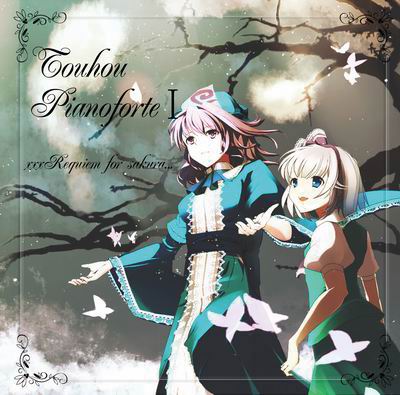 |
| Yuyuko lookin' boss, Youmu lookin' QUALITY |
Unfortunately, I can find only two tracks from this album on youtube, both uploaded by kkcwkoh. I'll go ahead and say that it's worth downloading, or, if you live in Japan and are actually able to buy it, buying.
Because of its nature as piano variations on Touhou music, mostly from Perfect Cherry Blossom, I'm afraid I don't have as much to talk about. It opens with the "ZUN scale progression," naturally, but moves on to, actually, a rather powerful motif on Sakura, Sakura, which is fitting with the whole "Perfect Cherry Blossom" thing, and also thematically, since contrary to popular belief, the song was only popularized in its modern form in the Meiji period (though the melody was from Edo), when Japan was modernizing, and the romanticization of its history began. This is the era that Gensokyo appears to be in technologically as well. All this weaves in quite well with a variation on Ancient Temple, one of ZUN's more under-recognized compositions, played with feeling and flare. Next is a very dizzy, formless, yet still strong variation on Mystic Dream. After this is a variation on Hiroari Shoots a Strange Bird (another one of Youmu's themes), this time much stronger in its central themes. It captures the feel of the original better than the original did, in some ways. The Sakura, Sakura motif returns in the next track, which is a variation on Ultimate Truth. It doesn't feel as strong as some of the other tracks on the album, but as a relative measure, this is meaningless, since the rest of the album is so awesome. A variation on The Doll Maker of Bucharesti is next. Alice's themes are some of my favorites from PCB, and this track is one of the best on the album. Next is a variation on Paradise, a track I'm actually not as familiar with. However, the arrangement itself is very nice, and played with the characteristic flare. I'm even less familiar with the next track, Prayer in Service of the Sky ~ Towards Equal Heights, mainly because it's not actually from Touhou, but Clannad, an anime. I've never seen Clannad, but it has quite a large fandom. I imagine that if I saw it, I'd like, but it is, at its core, a soap-opera, so I'm not sure if I could ever take myself seriously again. Then again, I loved every panel of Touhou Tonari, so I guess I already kinda can't take myself seriously. Anyway, the track is good, and even though it's quite obviously not ZUN's style, it's still Tomoya-san's, so it's all good. Next, going apparently in reverse order, is a very nice variation on The Fantastic Tale of Touno. The album concludes with a variation on Phantom Ensemble, a very nice end to the album, embodying quite a few of the themes present throughout.
It's an extraordinary album, carrying the atmosphere of PCB's soundtrack perfectly, except for the recording hiccups. It's probably my favorite Touhou piano album. I once played this album for a friend of mine who listens to almost nothing but top 40 stations and has been exposed to very, very little Japanese otaku culture, and he said he very much enjoyed it. If that's not an endorsement, I don't really know what is.
Symphonic Suite: Embodiment of the Scarlet Devil
In my ideal world, someone would get ZUN's permission (or heck, maybe even inspire ZUN to do it himself, the lazy drunk) to write a symphonic suite based on Embodiment of the Scarlet Devil. Since Touhou fandom is rather large in Japan, I think someone could conceivably convince even the Tokyo Philharmonic to do it. Hey, they've done Final Fantasy, though granted, Nobuo Uematsu is a respected name in higher circles, and Junnya Ota really isn't. If it's a success, then there are still seven more games to do, not to mention all the spin-off games ZUN has composed music for.
If I were to undertake the task of adapting ZUN for orchestra, a task I'm in no way qualified to do, despite the meaningless jargon I throw around, I'd try to keep a few things in mind. First, while Touhou compositions work because of melody, the also work because of their unique atmospheres, so having the whole string section playing the same part simply won't do. Any Touhou orchestration has to emphasize solo performances and interplay, perhaps using instrument combinations not often seen in more traditional video game arrangements. TAMusic has demonstrated that simple violin and piano can go a long way. Too many have forgotten that large orchestras originally evolved for variety and flavor, not for redoubling the same handful of sounds. Speaking of which, I also imagine that, if at all possible, a clavichord would be most useful to the orchestra. I should also think that choruses should be spared for the most part. There are few tracks that I think would really benefit from that sort of aesthetic, but on the other hand, using them for the tracks that are already supposed to be bombastic, like U.N. Owen Was Her, might work. The trope became popular for a very good reason, it's just that people keep on using it without understanding what makes it work.
One Winged Vampire. Lol.
Anyway, I'm thinking the chances of this happening are very much dependent on what mood ZUN is in, and knowing ZUN, that means it's pretty darn unlikely, but one can hope. Perhaps we'll continue to see things like the performance in the video above. This isn't what I had in mind, stylistically or otherwise, but having anything Touhou played by an actual orchestra is pretty darn cool.
On the other hand, maybe all we need is a good ol' tavern bard.


