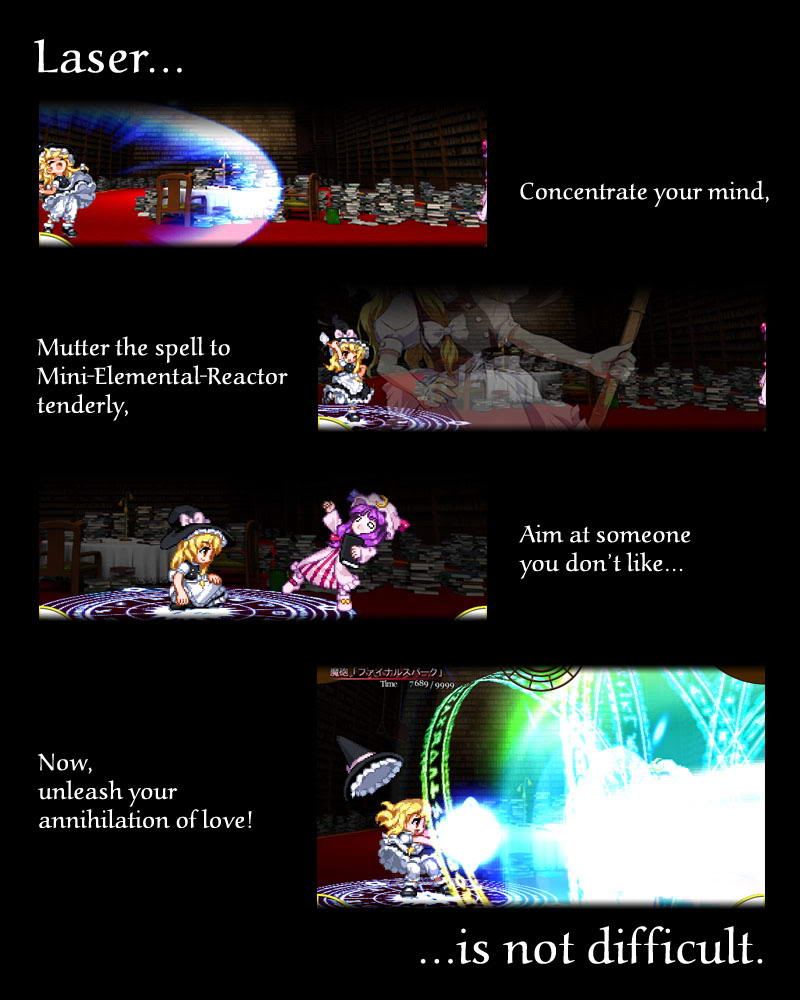
Here, have some text.

Sunday, October 30, 2011

Weird People: Like Sorcerers, Vampires, and Musicians

Less than a month.  This has to be a new record for me.

But, I'm sitting here in the dark, earbuds in, on my bed, blocking out the world around me.  Perfect hikikomori mode.  I am the ghost without a shell, a construct of the internet, existing in the real world as only a server.

Someone should really tell Major Kusanagi about this.

Anyway, I've been doing quite a lot since my last entry here, but I don't have nearly the time and will to go into all of it, and I doubt that'd be interesting at all to read anyway.  Ace Combat Assault Horizon was cool, but if you want my full opinion, you can read it here.  I still haven't really had the time or will to play it much more, but I definitely will be.  I never did get that month of XBL like I intended to.  I've been watching online gameplay videos though, and it looks like it'd be pretty fun.  From the looks of it, my predictions about the piloting skills of the average player were spot on.  PositronCannon - a guy from ACS who seems to be about my skill level (at least, he seems to make the same mistakes as I do) - recently posted this rather...interesting...footage of him dealing handily with a bunch of Raptor and Pak-FA fodder in an orange and black F-14.  He's Spanish too, and his team-mates opponents seem to be American, so that's even with the lag disadvantage.  Full of lulz all around.

But really now, what am I doing?

You know what, screw the format.

Embodiment of the Scarlet Devil (Or, how I learned to stop worrying and love the bomb)
The last few posts I've made have talked a lot about Touhou fandom, but I had never actually gotten around to playing any of the Touhou games.  I never really even bothered to describe what they were actually like.  This was mainly because the games are a) for Windows and b) not available in America.  The latter turned out to be more of a problem, since coming across a download of the games from a not totally sketchy source turned out to be pretty difficult.

Then I came across this site.  Mac ports of almost all the Windows era Touhou games.  I'm tempted to embellish and say within an instant, I was simultaneously downloading all that was available, but no.  I figure I'll beat each one in sequence.

So, I downloaded the first of the Windows era Touhou games: Embodiment of the Scarlet Devil.  Here is told the story of how Remilia Scarlet - the 500 year old vampire - decides one day that she's tired of having to walk around everywhere with a parasol.  The obvious solution to her is to cover Gensokyo in red mist.  She sees no problem with this.  Reimu Hakurei - the incredibly lazy shrine maiden of the Hakurei Shrine - and Marisa Kirisame - the tomboyish ordinary human magician and kleptomaniac - both do.

And that's about all I can get, because the port is not exactly perfect: the dialog boxes are illegible.  As Touhou is known among other things for its witty dialog, this is a bit unfortunate, and I'm currently searching for a patch, and failing that, for the documentation so I can try and fix the problem myself.  It seems this is a common problem with WINE based ports (haha, port wines), so I'm guessing I'm not the only one.  At least it's translated, however dubiously; I certainly wasn't going to be able to try and figure out kanji while trying to walk through rain without getting wet.

Still, I don't mind too much: just playing the game is fun enough, and it is a very fun game.  See, you control your character - either Reimu or Marisa - as she flies through the wards and lesser beings blocking her way, investigating the cause of this rather disagreeable red mist, and encountering and challenging the denizens of Gensokyo who get in her way.  While lesser opponents and wards will just throw large quantities of magical "bullets" at you in vague patterns, the attacks of Gensokyo's more dangerous denizens are elaborate and beautiful patterns that must be studied and learned to reliably survive.  As you knock out or survive opponents (you are not fighting to kill, nor are your opponents), you collect power-ups to slowly improve the spread and power of your attack.  If you are on the verge of getting hit, you can use a sort of spell referred to as a "bomb" (also known as the "fuck-no-I'm-not-dealing-with-this button") to clear the screen of bullets and hurt any opponents in your way.  Marisa's signature master spark is one of many such moves (Reimu's counterpart being the less flashy but equally effective fantasy seal).

I'm not sure it's obvious from what I just said why one would need something like a bomb.  Well, when I said "large quantities of magical bullets" I did not mean merely "a bunch" or even "lots."  What I meant was this:
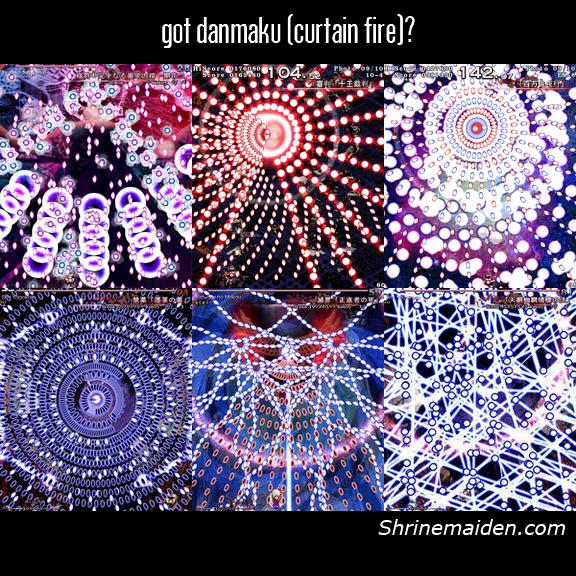
Yeah, it's not a game for people who haven't already developed the dexterity from playing games over the years to maneuver through the curtains of arcane power that descend down upon you on a regular basis.  Or patience.  If you're doing it right, you will be seeing patterns of glowing dots when you close your eyes.  I'm not even kidding.  This would have been totally the shit during the late 60s and early 70s.

Anyway, I'm good at seeing patterns, and I'm pretty good with delicate maneuvering, but even then, I'm still trying to beat EoSD on normal.  As of now, I can get through the first few levels (up to and through Patchouli) on normal, only losing a life or two, no continues.  Sakuya and Remilia, however, freaking wipe the floor with me.  Still, I did manage to clear Sakuya at least once (albeit using all of my continues), so I have her stage unlocked for practice.  Once I learn her patterns, I'm guessing it'll be much easier.  How does one fight against someone who can freaking stop time though?  Not even the power of Marisa's love colored master spark can deal with that.

My default excuse for getting hit by a really easy-to-avoid attack is "I got distracted by the music."  Of course, this only actually happened once, fighting Patchy Patchouli, enjoying her theme - locked girl - and drifting carelessly into a spoke.  It's said that ZUN makes these games in part just as an excuse for him to compose music, and I believe it.  The music is amazing (that's how I got introduced in the first place), but it's also your biggest enemy.

Well, Sakuya's theme in EoSD isn't actually that great, but her other theme - Flowering Night - makes up for it completely.  Can't remember which game it's from, though.  I guess I'll just have to beat them all until I get to the right one.

Anyway, here are some things I've picked up about playing Touhou:

- It may look random, but they actually are trying to hit you, so skirting the edges will never work. Stop trying.
- I don't know why Cirno gets all the credit for being an idiot: Rumia's spell cards are even derpier. This does not mean you get to try it pacifist style on your first run-through.
- Just because you've already memorized the pattern doesn't mean you don't have to look where you're going.
- Hong Meiling: the force is weak in this one.  No, you're still not allowed to blink, blinking is for the transient people weak.
- The small fry are often more dangerous than the bosses, if only because their attacks are more random.  At least the bosses bother to make theirs pretty.
- ZUN really does suck at drawing.  Great fashion sense though.
- And yet, Patchy's Patchouli's sprite appears to be wearing pajamas.  Actually, that makes sense, her being the shut in librarian of the Scarlet Devil Mansion and all.
- Potentially insane walls of doom can be pretty easily defeated just by quickly aiming for the load bearing enemy.  So stop bombing the small fry just because it looks scary.
- Reimu may be canonically the more powerful one, but Marisa is easier to play, if only because she doesn't blend in with the backgrounds as much.
- Speaking of which, attack power-ups tend to look a lot like bullets.  One will hurt a lot more than the other.  Do yourself a favor and don't try to pick up bullets or dodge power-ups.
- When in doubt, MASTAAAAA SPAAAAAAAKU! *BWAOOOOOOOOOOOM*


Another Day, Another Doujin Album
Well, I took a break writing this entry, and I've come back to it the next day.  Apparently, it snowed overnight.  I should not have implied Cirno was an idiot.  Even though she totally i-*icicle comes crashing through window*

Did you know how brilliant Cirno is?  It's incredible, really.  From now on, all my math is on a nonadecimal base, in honor of the ⑨.  2+2=4.44 now.  A centimeter is 9 millimeters.  The ten commandments are now nine.  All will be ⑨.

Anyway, since my last post, I've downloaded and listened to way too many doujin albums to talk about every single one, and the problem is, some of them aren't really interesting enough to warrant talking about in full anyway.  I'll go ahead and mention the ones I didn't get to though:

Album: Ace Combat Assault Horizon OST
Composer: Keiki Kobayashi
Remarks: I forgot to mention this: I also found the OST for ACAH.  It's probably one of Kobayashi-san's better soundtracks, but so much of the album (all four disks worth) is filler that I haven't even listened to all of it yet.  The only ones you absolutely must listen to are White Devil, and especially Naval Warfare (for which it's officially mandated you turn up the volume for).

Album: Blue Constellations
Circle: Sound Online
Remarks: It's actually a pretty interesting pure electro sort of album.  It reminds me of the soundtrack to WipEout Pure.  Neither is it brilliant in the same ways as some other albums.  Tsukasa has a very direct, very pure sort of sound, and it comes through well here.

Album: The Garnet Star
Circle: Alstroemeria Records
Remarks: Minoshima at his least remarkable.  He goes for a different, almost trance sort of sound here, and it doesn't quite work.  It's nice and atmospheric, but really, besides for the afterwards often remixed Maple Wizen, I can't think of a single truly memorable track.

Album: Double Counterpoint
Circle: Alstroemeria Records
Remarks: It seems to lack the cohesive and pervasive soul an Alstroemeria Records album usually has.  There are some interesting ideas here, but none of them work, and none of it really feels right.  Ironically, none of the tracks even seem to use double counterpoint, at least not that I noticed.  Also, it has one of the most QUALITY looking covers on an Alstroemeria album I've yet seen.

Album: Trois Bleu
Circle: Sound Online
Remarks: More hard edged Tsukasa electro, this time with a fair bit more Minoshima and REDALiCE mixed in.  I compared Tsukasa's tracks to the sort of thing found in WipEout Pure earlier without realizing that the first track in Trois Bleu was named the same as the first track on the WipEout Pure OST.  Compare the style of the two for yourself.  Boot Up (Tsukasa)  Boot Up (Paul Hartnoll)

Album: Where Is Love
Circle: Syrup Comfiture (Syrufit)
Remarks: This album is never not interesting.  I'm not in love with it the same way I am with show me your love, but it's got a lot of really interesting ideas.  More so than show me your love, this is not a pure Syrufit album: there's a very wide variety of styles on here, and if I had more time, I'd like to go into some of the more stand out tracks.  Putting it shortly, it's an album with this, this, and this all at the same time.  That last one is really different even for REDALiCE.  Not all of it works, but it's kinda neat, even if I don't find myself listening to it as often.

Anyway, I guess I should stop wasting you guy's time and get to the main points.

Flowering ERINNNNNN!!
Pictured: Kaguya Houraisan, Erin doll,
stuffed rabbit.  Believe it or not, this
will kinda make sense to fans.
Oh boy, this is going to be an interesting one to talk about.  Everything else that's come before may be based on Touhou music, but none of it is inextricably tied to Touhou fandom.  For COOL&CREATE, this is not the case.  Almost all of the songs on this album are referential to things in Touhou and Touhou fandom, and though you need not understand these things to appreciate the music, talking about the music sort of requires it.

To start with, I guess I should say that COOL&CREATE is a band created by its main singer, BeatMario (ビートまりお).  I'd call them, if I had to, something like indie rock, but that's a very, very general sort of rule.

This album in particular starts out with two live recordings.  BeatMario asks the audience (in Japanese) "Say, do you guys like Marisa?" The answer is a resounding "HAI," and the band goes into a live version of LaserMari is not difficult, a song released under the IOSYS label, based on Marisa Kirisame's theme Love Colored Master Spark, and in reference to ZUN's infamous instructions on how to perform Marisa's master spark.  Next is a live performance of their version of Locked Girl, a song about the eponymous locked girl herself, Patchy Patchouli Knowledge.  This is not the only song on this album about her, so expect to hear this pretty often.  Hey, she's a cool character, and her theme song is awesome, so I really can't blame him.  The video I linked to is not the version on the album, btw, but it does include a short clip of BeatMario interacting with the audience, which is always funny, if you're one of those weird people like me who for some reason thought it'd be a good idea to study Japanese.

Anyway, next up is drizzly rain, or rather a studio, more traditional rock arrangement of COOL&CREATE's own drizzly rain.  Also about Patchy Patchouli.  Like I said.  All I could visualize when I first heard this song was a Pokemon game encounter:
-A wild PATCHOULI appears-
The "ooooooooaaaaaaaaaaa-PATCHOULI!" sounds for all the world like pokéspeak.  I'm imagining throwing a pokeball and this amiable asthmatic bibliophile who looks like she's wearing pajamas coming out.
-PATCHOULI uses Fire Sign: Agni Shine High Level-
*everything within half a mile is razed*

There are about a hundred different version of drizzly rain out there, if simply because it's a fun song to do karaoke style.  BeatMario himself has a vocal version, and it's hilariously awesome.  It's amusing what notes he can actually hit when he's trying.  Then, just to be totally inconsistent, a smooth jazzy version of Library Sounds, based on Voile, The Magic Library.  Yet another theme tangentially related to our favorite shut-in librarian.  Oh well, it's actually pretty cool.

Next is probably one of COOL&CREATE's more well known tracks, Help me, ERINNNNNN!  This is one of those lucky few songs where I can actually sorta kinda understand the lyrics, which are about the eponymous put-upon lunarian archer and pharmacist Eirin Yagokoro and her fellow denizens in Eientei.  It's got a catchy structure, based upon, actually, not Eirin's theme, but Kaguya Houraisan's.  The live versions of this song deserve special mention for being the only place you'll ever see a crowd of Japanese people shouting "oppai, oppai" (boobs, boobs).

What can follow something like that?  Of course, a version of UN Owen Was Her featuring BeatMario doing what many do while listening to UN Owen Was Her: going radadadaraaaradararada-raradaradadaradararadarada~  Why does this need to exist?  I dunno, but it's cool I guess.  Anyway, it's followed by a fusion sort of track called Re: The Title Lies In...You.  Not sure what it's from, but it's kinda nice.  After that is a bunch of bonus tracks, including a conversation among the band that my Japanese is not nearly good enough to understand, a Touhou parody of the Lucky Star theme, and a version of drizzly rain being sung at karaoke drunkenly by one of the non singing (for obvious reasons) band members.

Komachi Onozuka: slacker god,
boatwoman of the Sanzu River, and
now, really creepy pin-up model.
Fragment Reactions
Alstroemeria Records does not have a perfect track record.  Double Counterpoint is mostly a waste of disk space, as is The Garnet Star.  But, when Minoshima-san gets it right, he gets it very right.  For Fragment Reactions, he got it very right.

We get the traditional Alstroemeria opening with the short intro leading into the first track, and both have a heck of a lot to be said of them.  Riverside View/End of Daylight opens with the sampled loop "909, 009, 009, 003."  Oddly intense, actually.  The Riverside View part is based on Komachi's theme, which I actually didn't realize for the longest time: it sounds like Minoshima-san through and through.  It's cool and all, and it leads into the longish house track End of Daylight, a very atmospheric and yet melodic track with vocals from Nachi Sakagami.  It's very laid back despite its strong melody...but appearances are decieving.  Take a gander at them lyrics.  That's right, this is a song about the end of the world, and how hope at this point would only bring sorrow, so you should just embrace the end...set to a snappy dance beat (lyrics courtesy of kafkafuura: always a reliable source).  The thing is, almost all Alstroemeria Records songs are like this.  It's kinda funny, actually.

Anyway, then comes the more upbeat Syrufit track lure to me, in which Mei Ayakura proves yet again why she's the strongest singer in Alstroemeria (and Syrufit proves yet again why he's better at arranging vocals).  Minoshima-san takes it again for Scarlet Fogbound, a house track done in Minoshima-san's traditional high-range atmospheric style, and done quite well, with an interesting minor key segment leading in.  Eternal Dream is very similar in that way, though it's a ROSVIO track (not too familiar with his work).  Following that is Stitch'step, an (EastNewSound) track.  I haven't actually downloaded any of (EastNewSound)'s independent albums, but what I've heard of them has been good.  Stitch'step is a strong and melodic track, with some rather interesting things going on with harmony and instrumentation.  And they also know how to arrange for vocals.  Lunatic Princess, taking its name and being based (surprisingly loosely) on Kaguya's theme: Lunatic Princess.  It's pretty normal downbeat Minoshima, but quite pleasant.  Lotus Road is another sort of downbeat Minoshima track, this time with vocals by *mican.  Tsukasa makes an appearance in his customary style with Booster (just by the name itself, its sounds like a Tsukasa track), a non-vocal track with an interesting, modulated synth centered sound.  Volcano in CHINA is probably the closest you'll ever hear Minoshima come to dubstep.  It's different for him, and it works pretty well, even if it does take just a few too many direct cues from China's Hong Meiling's theme.  Fragment Reaction, the next to last and eponymous track, is another pleasant arragement by Minoshima-san, though really at this point, as good as he is, his work in between Plastik World and Haunted Dancehall kinda runs together.  The last track is a Syrufit arrangement: Saint.  Actually, it sounds quite a bit more like Minoshima than it does Syrufit, for some reason, but it brings the album to a nice close.

In all, I'd probably call this album at least as good as Plastik World, if not better in some ways.  I can't quite decide which I like better: they're different in tone and style.  Perhaps Plastik World has the benefit of being slightly more focused: less time to get bored of the bland vocals and more focus on the things that make Alstroemeria tracks actually special.

REBIRTH
Wait, what?
METAL AND TOUHOU GO TOGETHER QUITE WELL, ACTUALLY.  A testament to this fact is the band Unlucky Morpheus (I assume this is a reference to Greek mythology and not The Matrix, but I could be wrong), and their album, REBIRTH, is as well.  Specifically, I'd have to call them a power metal band, akin very much to Powerglove.

Ironically, their album starts out in a manner very similar to an Alstroemeria album: an original intro into a longer song.  Specifically, the intro, REBIRTH, leads into their version of Faith is for the Transient People.  Which, you know, is actually kinda already metal-ish.  Anyway, it's totally awesome.  The next track, Missing Girl, is another fairly straight forward adaptation of The Primal Scene of Japan the Girl Saw.  It too is awesome, but at this point, it becomes clear that their drummer really doesn't have any ideas.  Really, good and creative drummers are harder to come across than people seem to realize.  So, once Unlucky Morpheus had a Missing Girl, they needed an Unknown Child: Unlucky Morpheus' version of UN Owen Was Her.  Few other Touhou songs save Lunatic Eyes have cried out for a metal version more than Flandre's theme, and though this is not the way I would have done it, it's still pretty awesome.  The one truly great feature of this song is how it handles the bridge section, with the call-and-response structure.  It does due credit to Flandre's mix of total creepiness and badassery.  This is followed by Kero⑨Destiny a short arrangement of Native Faith (which I cannot find, so enjoy that other, more well known, very much not metal arrangement), leading into their version of Autumn Waterfall.  It's pretty straight forward, but it's competent, and cool.  It also seems like even though good metal drummers are hard to come by, all the good singers flock to metal bands like iron to magnets.  Then again, having a powerful voice is a requirement if you're doing metal, just so the voice doesn't get overpowered.  Anyway, the next song is Heaped Heart, an arrangement of Mysterious Mountain.  The structure of this one feels different: there seem to be subtle time shifts here and there, and it works.  No Grudge Anymore feels different too: slightly more melody focused, and...is that Pachelbel's canon?  No...no not quite.  Thank god.  It's an adaptation of Mima's theme, an important character in the early PC-98 Touhou games who kinda disappeared in the Windows era.  The final track is The Gensokyo the Gods Loved.  This is the name of the track in the Touhou games too: the name already has a perfect metal vibe, I think.  ZUN said that he wrote the original to be very melodic, and so is Unlucky Morpheus' version.  It's a good note to end on.  Unfortunately, I cannot find it on youtube, but I did find a version by Sonic Hybrid Orchestra.  With pretty clear English vocals, strangely enough.  I'm going to have to check these guys out later: they're pretty darn good.

Anyway, personally, I was hoping for something a little more like Wishmaster than Power Rangers.  Then again, what can you expect?  Nightwish not only has the awesome singers (both, none of this Tarja vs Anette stuff), but also the drummer, the guitarist, and the everything.  It's still a really fun album, and I'll be looking to see what else they've done.

Incidentally, I just noticed something in the Power Ranger's theme song: the lines "They know the fate of the world is lying in their hands.  They know to only use their weapon in defense."  To be honest, if the fate of the world is lying in their hands, I'd really hope they know that they may have to use their weapons for something other than defense.  Like saving the world.  But that's totally off topic.

show me your love
Not gonna lie: I want to be that
timepiece.
i gotta admit, i'm kinda in love with this album.  I love Syrufit's style, I love the album cover, and hey, Syrufit himself seems like a pretty nice guy.  He responded to my post on his FB page's wall, and in very good English too.  Could use some work naming his albums and finding the shift key though, but hey.

So on topic, the first track, Your Love, starts off sounding a bit like something on the Weather Channel.  And, really, stays that way through half of the song before growing into a stronger sort of vocal centered track.  For setting the atmosphere, it works well.  Of course, following it is the very un-Weather Channel like Wheel, an interesting, more traditional sort of danceable house track, with a strong central aesthetic and progression to it.  After this comes recollection, an interesting track with complex rhythms and vocal parts, creating a very nice overall feel.  It should probably be noted that both of these songs' vocals are performed by Mei Ayakura.  Syrufit understands vocalists and vocal arrangement quite well, I think.  The next track, Sweet sigh, is slightly less impressive by virtue of being a bit more of a straight forward house dance number, but it's still quite nice.  It's also not on youtube anywhere.  TAK-sk did the next track, liberate me, a very nice, aesthetic centered track with a nice progression.  Very good, and again, not on youtube, for whatever reason.  Syrufit returns for perhaps my favorite track, Hitokata (untranslated Japanese for "forms of people," or, alternatively, "humanoid").  It's got some interesting, almost modal sort of harmonies and aesthetics to it.  It flows extraordinarily well, and the vocal performance - by one SHIKI - is very genuinely done.  Something oddly ephemeral about it.  It's hiro.na's turn for the next track: The world of noise, which, unlike what you'd expect, isn't all that noisy at all.  In fact, it's quite laid back, moreso even than most of Syrufit's generally laid back tracks.  Which I can't find on youtube either.  Uy.  I'd upload some of these myself, but then I'd feel ethically obliged to ask Syrufit himself for permission since I know he'll probably respond, and that would be really awkward.  Then again, it's technically not his track, so...  But anyway, speaking of which, Syrufit comes back again for Power of Wind, which sounds almost like an Alstroemeria track with the instrumentation, but still retains Syrufit's sensibilities in a higher sense.  By which I mean, the vocals - performed by this rather talented SHIKI girl again - actually work.  Which is odd, because it's not only not an arrangement of a Touhou song, it's a pretty direct remix of Power of Sound by Ace.  I don't really hold it against him: we already have plenty of proof he can come up with his own material too, and that it's pretty awesome.  It undeniably sounds like Syrufit anyway, so hey.  Of course, it's also hilarious that Power of Sound's lyrics are about finding love, and Power of Wind's lyrics are about the sorrow of being unable to realize the visions of the ego.  Existential ennui to a snappy dance beat.  Is Japan really that depressing?  Anyway, it's back to hiro.na for AraHitoGami (untranslated Japanese for Living God), another really laid back sort of track, like The world of noise.  And, like The world of noise, not on youtube.  The well named outro side brings the album to a nice not-quite-close with a rhythm and pad centered aesthetic.  And yes, that was the only video I could find.  I say not-quite-close, because that's actually not the last track.  The last track is ren (I guess like the Confucian concept or something), another hiro.na track with a very singular percussion arrangement, which really does bring the album to quite the nice conclusion.

Like I said, it's quite the album.  Syrufit also has a few other albums, most in cooperation with *poplica.  I hesitate to go ahead and download them only because even though *poplica is good, and there are a lot of tracks that are just *poplica or just Syrufit, there are also a lot of collaborative tracks, and the only people I know of who consistently do collaborative tracks well are Thomas Bangalter and Guy Homem de Saint Cristo of Daft Punk, and they can pull it off only because they more or less learned music composition together in the first place.  The result of collaboration in music is almost always a lesser result than if either of them had created a track on their own.  I'll still look into it though.

Other Stuff
I don't want to write full sections about any of this, because I don't think it'd be too interesting, and I don't really feel like it, so I'll just talk quickly.

Arase Kisama: Human female
wizard.  17, 6'2", blonde hair,
brash...she's trouble, man.
I joined a D&D Pathfinder campaign last monday as a female human wizard of the evocation school known as Arase Kisama.  Me and my fellow adventurers are to explore the island we're all on, and it seems like a dangerous but profitable venture.  Arase doesn't much like the whole danger thing, but it does seem like a good way to pick up some arcane knowledge (not to mention books and valuables), so she's pretty exited.  She and the half undead sorcerer Ackbar met up with the rest of the party in the light of a giant beacon at the top of an enormous Ziggurat.  The monolingual ranger was frustrated with the trilingual conversation going on in common, draconic, and tengugo simultaneously.  Arase saw this and threw in a clause or two in primordial just to screw with everybody.  The sorcerer also nearly got mauled by the Kobold when he tried to hug her, but everything got sorted out with only minor injuries.

As they meet, just what precisely the giant light is for worries Arase, but she and the party had other things to worry about.  For instance, the other wizard had run off into the woods never to return, and he had all the rope.  When the party had to climb the cliff to get back up - and eventually back to camp - there was no way of doing so.  Arase was the only one with rope, and she only had 50'.  So, the Tengu - Tetsuo - had to scale the cliff to find some vines to drop down.  Tetsuo nearly fell to his death, in fact, and it's possible that had it not been for Arase's feather-fall cantrip, he might not have made it.  As it was, he climbed back up, this time successfully, and dropped down some vines and Arase's 50' rope.  Arase herself had to try a couple of times to get started, but she managed to pretend to be all cool and stuff back at the top.

As they walked back, the ranger, sorcerer, and Arase noticed bear-like footprints. Confused as to why a bear would be in a jungle, and wanting to kill it so they could sell its skull to the goblins, they began to track them.  It was the sorcerer who realized that these were likely not the tracks of a bear but of an owlbear.  Still, they continued on to the owlbear's lair.  As the party drew near, there was a sound from the cave, and it became apparent that the owlbear knew they were there.  Tetsuo quickly darted to the flank.  Arase, pumped up on adrenaline and wanting to make a good first impression, raises her arcane bonded gauntlet and cries STELLAR RAINBOW as she casts evoke light, and a rainbow colored laser bursts from her palm.  Arase feels the power flowing through her, and for a moment, she almost grasps a power she had thought was unattainable, but it was not so.  The owlbear does not like this one bit, but he likes even less the half-orc smashing her giant hammer into its side.  The owlbear swipes with its giant left hand at the half-orc, who deflects the blow with her hammer.  She does not see the right hand as it rips into her side.  With this, the battle begins in earnest, the half-orc continuing to fight for a good minute before realizing how much stuff that should be inside her was now on the outside and fainting.  The ranger and tengu gunslinger pile on as well, dealing blows at close range.  Meanwhile Arase continues casting evoke lights and evoke force spells, as the sorcerer beside her casts evoke death.  Arase is impressed by the sorcerer's skill, but at the same time, "what's the point of magic if it's not flashy," she reasons, and evoke death is an ugly looking spell.  The owlbear continues to fight on, even after having most of its brain blasted away by guns and rainbow colored laser blasts, until in a last desperate effort to kill the ranger riding on its back, it digs its own claws into its spinal column and finally dies.  Nobody gets XP, not even the badass ranger.  The Kobold rushes forward to see what's in the cave.  Arase blows the faint smoke from off her gauntlet, straightens her hat, and follows.

I talked a few posts about Maikaze studio's A Summer Day's Dream, one of the two big doujin anime projects.  I mentioned that it was by far the lesser of the two, but I also said that I would be interested to see where it was going, if there was to ever be a second episode.  Well, as it turns out, a trailer for the next episode got released back late 2010.  With a promised release date for the next installment in late 2011.  Should be interesting.  If the trailer is any indication, the animation quality has improved, including, at least slightly, the facial animations and body language.  This is encouraging, but then again, this is only the trailer.  If it's still got the same questionable director attached to it, and the same questionable writer, then prettier is probably all it'll be.  But hey, for us Americans, it's pretty much free anyway, so I can't really complain about something I'm not actually paying for.  It's my choice whether I let something waste my time or not.

I gotta say though, as a trailer, this is actually pretty good.  So many trailers for both American movies and anime follow the same formula that to see a trailer do something even slightly different is pretty cool.  The last trailer I saw for a movie that I was genuinely impressed with was the one for David Fincher's adaptation of The Girl with the Dragon Tattoo.

Actually, that gives me an idea...

Okay, those sync up way better than they have any right to.

But anyway, I do wanna see a sequel to Memories of Phantasm too...

Speaking of anime, I'm still not quite done with Super Dimension Fortress Macross, but looking back on what I wrote earlier, I think I was way too harsh on it.  Yeah, it can get wicked cheesy sometimes, but for every bit of cheese, there actually is something of substance there too.  It's got some genuinely very interesting things to say about culture and war, about how culture is, in the end, a more powerful way to end war than military might, but yet how even in culture there will always exist war.  It's a nuanced view, and it's when the show explores these things that it becomes obvious that this is in fact the same executive director as Legend of the Galactic Heroes.

If I may touch on Touhou music one last time (I promise), I found a surprisingly cool German vocal version of Bad Apple!!  The lyrics flow very well (to the non-german speaker), and the singer is...well...actually better than nomico.  If she had been recorded in the same studio conditions, I'm thinking I'd actually prefer this version.  At least it's better than that really dire English version by Christina Vee.  I'm not even going to bother linking to that one.


Anyway, I really should be finishing this up now.
So now, for something completely different:

Saturday, October 8, 2011

Warwolf, Tally Two Youkai, Angels High, Engaging!

I don't have anything new, but I needed something here.  Sorry.
So yeah, remember how I promised an update by the Thursday before last?  Yeah, didn't happen, and now I actually have some more Alstroemeria Records albums to talk about (but that'll be the last part).  No more Touhou otherwise though, I promise.  I still haven't found a not sketchy way to play any of the games anyway, and I figure I'd better at least beat one on medium, just so that it doesn't seem too ridiculous that I've read and watched so much about characters that I haven't even seen the original versions of.

Speaking of which, I went on amazon.jp out of curiosity, and browsed through some of their stuff, and man is everything expensive.  I don't know if it's just the dollar being weak against the yen or something, but wow.  I'm definitely not buying anything from there anytime soon, especially not with US shipping expenses, which I imagine must be enormous too.  Also, kanji, kanji everywhere.  There's a joke that four years of Spanish lets you read a novel comfortably, and four years of Japanese lets you barely stumble your way through a comic.  Except it's not a joke, it's probably just a fact.  How does anything ever get done over there?  Oh wait, it doesn't, their government is at least as inefficient as ours is right now.

What Have I Been Playing?
Next Tuesday, the answer is going to be Ace Combat: Assault Horizon.  I downloaded the demo last Thursday and I've been playing it, getting used to the new physics and mechanics.  Planes handle more or less the same as in previous Ace Combat games.  The yaw and roll and pitch are pretty heavy when compared to something like Ace Combat 5 or Zero, but it actually reminds me a bit of Ace Combat 04's more floaty sort of handling.  What doesn't handle like any other console Ace Combat game is acceleration.  Tap the right trigger, and all of a sudden you're going 1500 knots and about to overshoot the Flanker F you've been chasing.  On the other hand, tap the left trigger and you're falling out of the sky.  It's very weird to get used to, but once I do, I imagine it'll just make maneuvering into position all the more precise and swift.  Still, I'll often try to merge with too much energy, or start a series of high alpha maneuvers with too little, and end up dangerously out of position in a way that would cause me a lot of trouble if I were playing against a human opponent.

Maneuvering into position is at the same time more important and less important in Ace Combat Assault Horizon.  With DFM - dogfight mode - you can tap the bumpers and enter this sort of chase scene thing where the enemy is trying to shake your pursuit and you have to try and follow and get off missile shots.  It's the only way to efficiently take down some enemies, and it's actually very cool, but on the other hand, reliance on the new feature means that Project Aces has made taking out aircraft outside of DFM rather more difficult.  Missiles do not track very well at all outside of DFM, requiring very good timing, judgement of energy, and positioning to get hits on the more difficult enemies.  Normal aircraft in ACAH have very passive AIs that seem content to take it in the rudder while you sit behind them and shoot 20mm cannon rounds in their general direction.  This is probably for the better, since the cannon in ACAH does not compensate for lead outside of DFM, so getting a gun track on the target at anything except point blank range is very hard, and is not helped by the fact that it takes a lot more to take down enemy planes in this game than in any other Ace Combat game before it.  Missiles work just fine though, and I can take normal enemies out without any more difficulty than in any other Ace Combat game.

There are also so called "target leads" though, that are much more difficult to engage outside of DFM because the designers did not intend for players to engage them outside of DFM.  Their AI is pretty lackluster - about the same as a normal aircraft in any other Ace Combat game - but man, does the computer ever cheat.  Most of them are scripted to be invincible outside of DFM, even though you can still score missile and gun hits, and I always forget which ones are which until I'll be chasing one, maneuver into position, watch the plane disappear behind a wall of smoke and flame, only to emerge unhurt from the other side.  They also tend to spam flares if you get too trigger happy with the missiles, which can be very difficult to deal with, and will defeat even the most well positioned missile shot.  They're very much like the Yellow squadron planes in AC04's Lifeline mission, and like them, I can still score enough missile hits on any given target lead that I'm pretty sure it'd be dead if it weren't protected by plot armor without much of an issue.  On the other hand, they're very good for training, just scoring missile hit after missile hit in preparation for dealing with the AIs in the real game, and potentially for other humans.

See, my colleagues at Ace Combat Skies have come up with a master plan.  There's a game mode in ACAH multiplayer called world domination, where the player chooses a city to join, and compete to take control of all the other cities of the world by flying combat sorties on the offense to new territories and in defense of their own.  Most of the best and experienced Ace Combat pilots in the western world (my humble self included) are on ACS, so this is what we're planning: everybody on the forums joins a really unpopular city, like Dubai, so that it's mostly just us and whatever other people that region manages to get, and together we take the rest of the online community by surprise and conquer the world with our hundred-or-so player army.  First, we would take Tokyo for the sake of the Japanophiles, then we'd take Hawai'i to take control of the world's hula girl stockpile, and then, the world.  They will come to know and fear the ACS clan tag.  Or we'll start in Honolulu and work the other way around, but in either case, it'll be hilarious, this faction that has such a small percent of the online community taking over the world.

Or so we hope.  It's actually more feasible than it sounds.  From what I've seen, most people, even experienced gamers who play flight games on occasion, really don't fly very well at all.  Heck, the professionals that play for the previews, who you'd think would be pretty experienced with this sort of game, fly horribly.  What with the influx of new people drawn to the steel carnage of Assault Horizon, the average opponent probably won't be much harder than the average AI.

Of course, if I wanted to take part in this glorious battle, I'd have to get Xbox Live Gold.  Which sucks.  Maybe if I pay my parents back, I can get a one month subscription, so I can help my comrades for the majority of the fighting.

Life?  What is this life you speak of?

What Am I Watching?
Drunk people outside my window, but that's not important right now.

No, but really, I've been watching Legend of the Galactic Heroes and Super Dimension Fortress Macross, but as I've already talked about both on here, and I don't really have anything more substantial to say about them, I'll leave it at that.  It did occur to me, however, that Legend of the Galactic Heroes isn't a space opera after all.  What it really is, is a historical epic that happens to be set in the future.  As the show's tagline says: Zu jeder Zeit, an jedem Ort, bleibt das Tun der Menschen das gleiche - in any age, in any place, the acts of men remain the same.  Holy crap is this show awesome, all the politics and history and personalities, and stuff, but of course, that's exactly why it'll never see the light of day stateside.  So ist das Leben.

how do i facial proportions plz k thanks
SDF Macross is still pretty good, like a slightly less stupid version of the original Battlestar Galactica, but that's really not saying much.  The characters aren't great, and the plot is kinda stupid at times, but it does have some genuinely great moments in it, and it's still something cool to put on during dinner.  It's also kind of funny just watching to find animation errors...which isn't that hard, because if I had a penny for every time someone goes off model or crosseyed or there's a sea of elementary school drawings in the background cells, then I'd be able to pay my own way through college.

On the Theoretical Basis Of Anime Clubs
I've thought about it a lot, and I've decided that I'm going to consider thinking about trying to start an anime club next year.  I've never run anything like a club before, and I'm not sure how one goes about starting one, but with all things, one must start with a purpose, and for something like an anime club, which you'd think would be more or less straight forward, there are some odd anomalies and contradictions that have to be solved to form a solid operating principle.  Here is how I see it.

Premise 1) Anime as a blanket concept has fans because there are things going on in Japanese animation that simply are not seen anywhere else.
- Anime itself covers a very wide range of formats and topics.  This results in many subfandoms; many people attracted to the same blanket concept of anime with very divergent tastes.
- Animation has certain inherent filmic qualities to it that are present across subgenres that nevertheless lend it to certain types of stories (mainly those dealing with subjects impractical or impossible to do in live action).
- Animation has certain inherent filmic qualities to it that make certain types of storytelling, character development, and atmosphere possible, whereas in live action it would be impossible.
- Anime undeniably has elements highly influenced by Japanese culture that inherently cannot be found anywhere else.
       - Interest in Japanese culture is not endemic with interest in anime.

Premise 2) Anime fandom itself is very diverse.
- There are many ways to be introduced to anime that each have their own canon of anime titles the fan is likely to be familiar with, and each attracting a different sort of taste.
       - Those introduced from Toonami/Cartoon Network will likely know things like Trigun, Cowboy BeBop, and Gundam Wing.  If they stayed around long enough, maybe FMA, FLCL, and Death Note.
       - Those introduced from the internet will have a very wide range, but will likely at least include Suzumiya Haruhi, and may also include things like Fate/Stay Night and Azumanga Daioh.  Madoka Magica may be on the list too.
       - Those introduced from film theory or a preexisting interest in Japan will likely know things like Akira, Ghost in the Shell, and at least a few Studio Ghibli films.
       - There are likely many fans who haven't seen much beyond Shonen Jump shows, like Naruto, Bleach, or One Piece, but are still undeniably part of anime fandom.

Premise 3) Anime fandom shares the uniting factor of being a fairly small community.
- Anime is largely accessible only through the internet.
- Anime fans are accessible and common only on the internet.
- Common interest in something uncommon is a uniting factor.  Anime fandom is quite uncommon.

Premise 4) Anime fandom is largely self sustaining.
- Anime fandom has its own reference pool, and therefore its own set of in jokes and memes.
       - Anime fandom also has the big three sub-fandoms: Vocaloid, Hetalia, and Touhou.
- Anime fandom is largely self-contained.
- Such a blanket sort of fandom inherently cannot be defined by a singular source material and therefore must be defined by the conception of its own fans.

Therefore An anime club must serve two separate imperatives.
1) An anime club must promote the concept of anime.
2) An anime club must promote anime fandom.

Things therefore entailed that an anime club must do.
- Meet.
- Watch anime.
       - Ideally, anime that exemplifies something inherently good about anime that all who appreciate anime can potentially enjoy regardless of what they're already familiar with.
- Discuss anime.
- Consume secondary media concerning anime.

Things therefore not entailed that an anime club do, but might be commendable.
- Hold events outside of itself.
- Attend events outside of itself.
- Collaborate with the Japanese club.
       - Anime as an interest is innately filmic rather than related to Japanese culture, but as the two are nonetheless interrelated, it might be in both our interests to occasionally work together.

Things therefore entailed that an anime club should never do.
- Promote ideals that are inherent to a specific subset of anime fandom but not applicable to a whole.  (in-joke focused shows like Lucky Star or any moe-for-the-sake-of-moe sort of shows fall under this category)
- Neglect moderation and leadership.
- Crossplay.


Practical concerns.
- We should probably not try to watch shows and OVAs longer than 15 episodes (so that they may be watched in three weeks or less).
- Unless it's unlicensed in the states, or unreasonably hard to obtain, we should only watch legal streams or DVDs, if for quality reasons alone.
- Meetings should probably be on Saturday so as not to conflict with homework or other clubs.
- Hentai would probably be a very bad idea.

First Three Things I've Unilaterally Decided We Should Watch
- Daicon IV Opening Animation (would make a good introduction on the first day)
- Ghost in the Shell (it's a truly great film with broad appeal that's not Ghibli)
- Puella Magi Madoka Magica (has things to offer to pretty much all types of anime fans, would introduce old school fans to what the new school has to offer, and fits perfectly into four episode arcs)


More Alstroemeria Records
Yep, there's more of them, and since y'all must have been so entertained by them last time, I've decided to do it again (don't worry, there's only two this time).


Harmony
"Yeah yeah, talk to the butterfly; I'm
gonna go to the ghost disco, but
not before I strike an elegant pose."
Well, it's probably not the best Alstroemeria Records album out there, but it's probably got the most awesome cover art, or if not the most awesome, the most descriptive.  I'll give you a hint: it's not power metal.

Alright, first off we have...wait...this is the right album, right?  Did I just accidentally turn on some mid 80s synth rock?  I dunno, but whatever it is, Cheek Colors has a pretty epic, 80s-tastic opening section.  It's pretty sweet...right up until the vocals start.  As much as I may complain about Nomico, at least she's accurate and has an interesting voice.  Haruna, the vocalist for Cheek Colors, very nearly ruins it, with one of the least charismatic, barely on key performances on an Alstroemeria track yet.  Anyway, still pretty cool, even if it's pretty pop-like for Minoshima.  I just wish the idea were done better justice.  After this are three songs I've already talked about because they were on Exserens (the compilation album): Dark Road, Alice Maestra, and Voile, The Magic Library.  After those three is Wind's Believer, a pretty good down-beat song in the same vein as the previous three, though also a bit more groovy with its baseline and percussion.  Misato also proves again why she's probably the best of the vocalists who contributes to Alstroemeria Records with a surprisingly effective performance.  The eponymous Harmony follows.  I gotta say, the grooviness of the track goes so well with the cover art that it's not even funny.  I get the feeling that this exactly the song the artist had in mind when he created it.  Following it up is Interlude, a Minoshima original and by far the most interesting track on the album, with its variable tempo, unconventional, almost tape-loop like vocal sampling, and general contrast with the rest of the album.  The next track is Maple Wizen (2007AW Re-Master), a very good example of Minoshima in laid back house dance mode, which is good, because it's seven minutes.  The last track is Suwa Foughten [sic] Field, and holy crap, did Minoshima san just figure out how to use nomico?  I mean, I call her helium voice, but she's actually pretty good when used right, like on this track.  Actually, I'm not sure Yuki Kajiura might not have had something to do with it.  Hmm...


Trois Noir
The god of nuclear fusion still
has yet to discover the secret
of how to sit in a chair.
Alstroemeria Records is not the only Doujin circle that composes tracks based on Touhou compositions.  Two of the most prominent DJs besides Minoshima san to do so are Sound Online (Tsukasa) and ALiCE'S_EMOTiON (also known as REDALiCE), and fortunately for us, they all seem like pretty good friends.  In fact, they decided one day to do a project together: a three part album called Trois, that would be composed of Trois Rouge (ALiCE'S_EMOTiON), Trois Noir (Alstroemeria Records), and Trois Bleu (Sound Online).  So far, I've only heard Alstroemeria's third of the project, but maybe later tonight even, I'll check out Tsukasa san's.  I've heard one or two of his tracks, and they're pretty good, and much more trance like in style.  Should be interesting.

Anyway, just like most Alstroemeria albums, Trois Noir starts with an original Minoshima composition that leads into the first track.  This time, the opening is Showdown/For Lovers Not Fighters, which in true Alstroemeria tradition, features an English phrase (telling us, apparently, to "eat it") looped to a very deep electronic organ like synth riff.  It's an interesting track for its instrumentation, even if compositionally it's very much traditional PlastiQ World Plastik World era Minoshima, and it still features the trademark bland Alstroemeria vocals, though thankfully within a reasonable octave this ti...HOLY CRAP, DID MISATO JUST TRY TO HIT F7?  I would have forgiven Minoshima if he had decided to autotune that, but I guess he has standards too.  This is followed by Flight on Tears, which reminds me very much of something that might have been on Lovelight, with the synth strings and upbeat melody, and a this time quite good vocal performance by Misato san.  Next is 光の都 (City of Light), which...wait a second, this is adapted from the same composition as the opening to Memories of Phantasm.  This one is a lot less normal-anime-OP-style, which makes sense, since it's not from an anime OP.  Also, it's actually a Sound Online track, which would explain why it...well...doesn't sound like Minoshima.  After this is...wait...this is WAY the hell not a Minoshima or Tsukasa track.  Underground Bridge, REDALiCE's main contribution to Noir, is far more like something you'd hear at a rave than anything else on any other Alstroemeria Records, but for what it is, it's a very good track, and it definitely still has a place on the album.  Well, I say that, and the next track, Nuclear Fusion couldn't be any more different if Minoshima had been trying.  Nuclear Fusion is much more like alternative rock than anything else I've ever head from Alstroemeria Records, and it works quite well.  Following is Last Remote, a...the hell do you call this?  It's not house, it's not alternative, it's not tanzmetall, it's...really heavy alternative synth rock?  The vocals are by Ayumi Nomiya, and are actually excellent for an Alstroemeria track.  Why don't we hear her more often?  Then comes REDALiCE'S remix of everyone's favorite, Bad Apple!!.  Or should I say, Rave Apple?  It's not incredible, but it's pretty hard to mess up Bad Apple.  Anyway, Gallardo (I haven't the faintest), a pretty typical Minoshima original, comes next.  Fortunately, typically Minoshima original tracks are pretty awesome.  Finally, the last track is a Sound Online remix of For Lovers Not Fighters, which, well, sounds like Tsukasa's version of For Lovers Not Fighters.  Which happens to be pretty awesome, actually.  A very atypical album for Alstroemeria Records, but a pretty good one nonetheless.


And now, remember that thing called the conservation of energy?  Screw that, physics is for dorks!  This is what a world where car tires can have a negative coefficient of friction looks like.

Sunday, September 25, 2011

A Youkai, a Miko, and a Rabbi Walk Into a Bar...

Commando Miko Reimu?  I guess.
We still love you.  Note: this is probably
the only time you'll see me draw fanart.
The bartender runs away because he's never seen a youkai.  Poor bartender: these jokes never end well for him.  No wonder Moe was always so morose on The Simpsons.

I wonder how many decades that show has left, anyway.  Ah well, I don't know the last time I watched a currently running show on the television that wasn't Doctor Who or Top Gear, the two biggest English cultural achievements of the last few decades.

Seriously though, Doctor Who has been getting very popular over here in the States lately.  Not surprising at all, really: it may still be a guy going around in a space-time-traversing police box dealing with the monsters of the week, but it's got some pretty great writing, and a very charismatic main character.  Not to mention, some of the monsters of the week are actually pretty awesome.  The Weeping Angels is one of the best ideas for a monster I've ever heard.  But, no, there are actually people here that care about Doctor Who, and the rule of this blog is that I have to talk about a lot of crap that nobody gives a shit about...yet, of course.

Note: I originally intended to write about a couple other, non-Touhou related things, but it seems there was a lot more here to cover than I originally had anticipated, so you guys get another all Touhou megapost.  Sorry.  I still plan on writing all those things, but I'm going to have to put it off until at least Thursday.

The Touhou Project: It's Not a Game, It's a Lifestyle
Well, not really, but the thing about Touhou is that it has a large fanbase, a loosely defined canon, and lots of really creative people.  It's not like something like Star Trek fandom, where there's a set canon and the fans wedge their own ideas into it.  Here, the fans are actively building the canon.  And it's pretty cool.

Alstroemeria Records
You may remember the song Bad Apple!! from my last post.  I did not mention that it was the work of one Masayoshi Minoshima, a house composer who runs the Touhou doujin circle Alstroemeria Records.  A doujin circle is, for the lack of a better word, something akin to The Gorrilaz: a project with a revolving door of talented artists working along the same theme.  Like with The Gorrilaz, this leads to a very eclectic selection of music that can range from electro-house to Daft Punk-esque funky sort of house to tracks that, if the vocals were sung a few octaves lower, would qualify as tanz-metall (like Bad Apple!! itself).  Almost all of it is at the very least good, and quite a lot of it is downright awesome.

The reason this is even related to Touhou is that many of the tracks are based on compositions for the games' soundtracks.  How it works for Alstroemeria Records though, is that they tend to sample in the same way that Daft Punk does: most of the time, it's hard to even identify what song it's sampling.  The new track is so very different from the track being sampled, it's crazy to hold it against the artist for doing so.  The difference between Daft Punk and Alstroemeria is, of course, that Daft Punk normally samples rather unremarkable songs, while Touhou's soundtracks are already incredible.

Many tracks have vocal elements as well, and most of the Japanese lyrics are actually very well written.  Alstroemeria Records also has a habit of having Engrish samples that it's quite obvious neither the composer nor the vocalist actually understand, and have no clue how to pronounce.  It took me a while to even realize that Plain Asia was supposed to be English at all.  In retrospect, maybe I should have known better.

I'll explain more about the strengths and weaknesses of Alstroemeria's vocals later, but even though I'm sure that the concept of singing in an octave below C4 is not completely alien to Japan, I'm pretty sure the news hasn't reached Minoshima-san yet.  Tracks where Nomico sings, especially, seem to never go below C5.

Anyway, because ZUN - Touhou's sole creator - doesn't allow merchandise to be sold officially outside of Japan, there's no legitimate method of buying any of Alstroemeria's albums.  On the other hand, this just gives me a good reason to download them off of mediafire, so yay.  Here are my thoughts on the albums I've downloaded so far, in chronological order.

Pictured: Reisen Undongein Inaba.
Not pictured: batshit insanity.
Lovelight
Lovelight is a very good album in all, even if it has fewer truly awesome tracks than, say, Plastik World.  The first track, the eponymous Lovelight, reminds me a little of some of Daft Punk's early work, with the strong riff and looped (Engrish) sample, creating a catchy and atmospheric track, albeit not a particularly complicated one.  After that, we get the afforementioned Bad Apple!!  It's a very heavy track, even for Minoshima-san, with a compositional style and intensity that make me wonder seriously what would happen if Rammstein's Till Lindermann sung the vocal part.  The lyrics have an especially melodic quality to them, and even though Nomico "Helium Girl's" vocals are normally far too high for my tastes, her performance is emotional and sharp enough that it works exceedingly well.  It's still probably my favorite song from Alstroemeria I've heard so far.  The next track, Magic Girl, is another great reason not to sample English lyrics if you don't know what they mean.  Withered Leaf is an interesting instrumental piece with some very good use of synth and real instrumentation working together in a way that contributes to atmosphere instead of dissonance.  Silver That Can Be Crushed Like Crystal is a long, fast paced instrumental piece, fairly unremarkable except for the fact that it sounds a lot like a dance version of Excalibur from Ace Combat Zero in places, for some reason.  Ultimate Truth and Interlude are both pretty cool electro-house sort of tracks, as is Fractal Night, which is a pretty direct arrangement of Flowering Night, one of my favorite Touhou compositions.  Extend Ash doesn't have much going for it one way or another, except for the strange decision to use a synth choir, which just plain doesn't work, in an album that is at the very least competent at everything else.  How Is Your Eyes Crazy? is another pretty straight forward adaptation of a Touhou composition, this time Lunatic Eyes, but in the translation, it loses the power of the original's epic riffs, which could have been really cool to hear arranged Bad Apple!! style.  As a whole, Lovelight is a very good album to turn on and chill out to some house tunes.

...why is Keine wearing lipstick?  Oh fan
art, how I love you.
Plastik World
It's a pretty fantastik album, probably Alstroemeria's most consistently awesome.  It's a lot heavier as a whole than Lovelight, meaning more frequently complex, stronger tracks, but it's also slightly more pop-like.  The album opens with God Know Will You To Love From True [sic]/Plain Asia, an (completely original) intro track by Minoshima-san, followed seamlessly by Plain Asia, so that it's really very difficult to separate the two.  As the album is seamless, this applies to a lot of the songs to varying degrees, though not as much as on Haunted Dancehall.  Also, Engrish.  Wheel of Fortune follows, which is pretty standard Mei Ayakura material, which, fortunately, is pretty awesome.  It's followed by another track by Ayakura-san, Saigetsu, which is probably my favorite track of the album.  It's notable for having a very interesting call-and-response duet structure between two singers, one in C3/4, and one in C5/6.  It, along with the rest of the album really, reminds me a bit of Kaskade at his best (I still don't know who did the vocals for Angel on my Shoulder, but whoever she was, why the hell doesn't Kaskade use her more often dammit.)  The next track, the eponymous Plastik World, also reminds me of Kaskade, this time of what Kaskade vocals sound like most of the time.  Still, a pretty cool track.  The next one, m9, is a pretty funky Minoshima original that provides some nice variation on an album that, if nothing else, has a very strong and consistent style.  Times, a fast, lighter sort of track, also helps, though the sort of rudderless vocals do little for it.  Following that up is Twilight Tea Room, a...very oddly JPop sort of track by Nachi Sakagami, who as far as I know hasn't composed anything else for Alstroemeria Records.  It's actually a pretty good track, but it's very strange for something off an Alstroemeria Records album.  The next to last track is a light piano Outro...which isn't actually an outro, because it's immediately followed by Leading Phantasy, which sounds a lot like it should be an anime theme song.  Actually, hold on a second...I knew it!

Busy album cover is busy.
Exserens
"Selections of Alstroemeria Records" claims the cursive subtitle, presumably in a French accent.  C'est vrai, Monsieur Subtitle, c'est vrai, and it seems like Minoshima-san picked well.  Predictably, the first track is Bad Apple!!  Fair game.  The second track is Dark Road, a pretty straight forward adaptation of The Road of the Apotropaic God, and which is probably one of my favorites from Alstroemeria Records in general.  Both versions have very strong motifs and well considered instrumentations.  Crystalize Silver and Dreaming are why I don't like Nomico, but they're still not actually bad, nor are they extraordinary.  Just...really...helium-y.  The vocals for Dreaming are partially based on Reimu Hakurei's theme, Maiden's Capriccio, which has another, more well-known adaptation, Neko Miko Reimu, for which the high octave makes slightly more sense.  Eighteen Four is another track with Misato's vocals, which, if nothing else, provide a nice change.  The instrumental arrangement is pretty blasé for an Alstroemeria Records track though.  However, it's followed by Dolls, which is a far stronger track compositionally, and makes good use of Misato's range.  It's followed, however, by Shinto Shrine, which sounds like it should be playing over the end credits for something, but is still a pretty solid, downtempo sort of track...which is a good thing, because it's also a good seven and a half minutes.  Then it's Helium Voice again for Shanhai [sic] Alice in 1884, another not bad but also slightly less good downtempo track.  This is followed by the very trance influenced Voile, The Magic Library, based on the Touhou composition of the same name.  This is probably the closest Minoshima has ever come to a by-the-numbers track of any genre, but it works.  Another trance influenced piece, Scolded By The Princess, clocks in at nine minutes and six seconds of laid back dance beats, and comes immediately after, so I hope you like FM Synthesis baselines.  Then it's time for more Helium with Alice Maestra, a pretty solid but unremarkable track, and The Last Judgement, another trance-like track, and probably the strongest of it's type on the album.  It leads into another one of Minoshima's piano Outros (which I can't find on youtube), which brings the album to a nice piano and synth string conclusion.

Youmu Konpaku: half ghost, master
swordsman, gardener, and now,
Alstroemeria's most adorable vocalist.
Haunted Dancehall
Alstroemeria Record's Most recent album, subtitled Living Dead <Danceable>, is also, while maybe not their best, in my opinion, almost certainly their most fun.  It's a completely seamless album, with songs often flowing into each other so well that it's hard to tell where one begins and the other ends.  For this reason, here's a youtube video of the whole album.  This is something you could just turn on at a dance party, and just leave playing, and it'd work perfectly.  Like in Plastique World Plastik World, it opens with a short Minoshima original, featuring a single looping Engrish phrase (Only In the Morning Upside Down After Moonlight), followed seamlessly by a song that builds off of it (Ancient).  At least for Only in the Morning Upside Down After Moonlight, the English is actually grammatical.  Together, the two tracks make for a fun, dangerously catchy, and surprisingly complex opening section, and includes some very cool polyphony with Mei Ayakura's vocals.  The next section, Witching Dream, is a pretty bright, funky house track in true Minoshima style (including another helium girl who's not Nomico, and who actually has a pretty good range).  This leads into an instrumental section - the eponymous Haunted Dancefloor - that reminds me an awful lot of Daft Punk's Voyager done Minoshima style.  This is followed by Border of Life, another pretty cool, bright house track, after which comes Little Love Girl.  Note, this is Little Love Girl, not Little Girl Love, which is how I keep on reading it; I don't know if it's me or Minoshima who's subconsciously a pedophile.  Anyway, it's another pretty solid track, though probably the closest the album ever comes to pop.  It quotes Cirno's theme, Beloved Tomboyish Daughter, in the vocals, even though it's not an adaptation in the same way some previous tracks on other albums have.  In fact, unless I'm mistaken, a significant amount of material on Haunted Dancehall is completely original.  Little Love Girl also provides a great example of why you really shouldn't be taking large samples of English vocals if you don't what they mean.  Unless Minoshima-san is really wondering "Where my homies at?  Where my bitches at?"  Which he could be, I understand the sentiment completely; I loose track of my homies and bitches all the time.  Anyway, this is followed by the funky (I've been using that word a lot in describing this album, haven't I) instrumental interlude Crescent Dream.  After this is Sky Ruin, another very nice entry, even if the vocals, while for once down in C3 throughout the song, are pretty non-desrcript.  The album ends with with Your Smile, Your Face, Your Lies, Your Love, a very nice nice track with some very nice percussive synth piano in the composition, and English lyrics that are grammatical and actually mean something (mispronounced as they may be).  I say it's the end of the album, and it is the end of the album as a contiguous whole, but it's not technically true, because it also includes a remix of Plain Asia from Plastisch Welt Plastik World.  It's a much lighter track than the original, but it works about as well.  Lots of glitchy sounds.  Very much old Minoshima in Nu-Minoshima form.

Anyway, there are still a few more albums I haven't downloaded yet, so I get to do this again for them too.  And who knows, maybe Alstroemeria Records will have another one for Comiket 82 (or whatever the next one is).

On Touhou Anime
I mentioned in the last post that a Touhou anime could stand to be very interesting, only peripherally knowing that there were already two examples of doujin produced anime's based on Touhou already in existence, one with a second episode already in production.  This is not the one I'd have preferred a second episode be made of, but I'll get into that later.  Neither of the two examples are quite there: they both have their strengths and weaknesses (the first mainly weaknesses), but they're both very interesting.

The first one of these is A Summer Day's Dream, produced by the independent studio Maikaze, and featuring some very well known Japanese voice actresses.  Now, the article on the Touhou wiki says it's uncertain where the studio found the money and the connections to get these voice actors, but to me it's pretty simple: they took it out of the budget for the animation and the rest of the staff.  Perhaps that's a bit harsh, but the truth of the matter is, despite ZUN's concerns that with such well known seiyuus attached to the project that people would mistake it for an official Touhou anime, there is no mistaking this for anything but a doujin production.  That said, this is still better than a lot of real, television anime that still manages to make money...somehow...so even though this isn't the best possible world, I'm glad this exists.

Let's start with what this does right.  As I mentioned before, it has some high profile voice actors in it, and the voice acting is, if nothing else, professional and competent.  This is the level of work you'd expect out of your average television anime, even if besides for Reimu and Marisa, nobody delivers much beyond the baseline of this-is-convincing-enough-to-overlook.  To be fair, they do their best with the dialog and direction they're given.  And that's where the trouble starts.  In neither of the two examples is the dialog by any means great, but in the other example that I'll get to, the dialog is written for real people that fit the basic framework.  This show has dialog written for the basic framework.  Okay, that's unfair too: a few characters - especially Reimu - have moments where they not only act like a human being would probably act, but act specifically like the human beings that they'd ideally be acting like.  They have their moments.  But for the rest of the time, they have the same plausibility as Hetalia characters.  (cue nerd rage)

This is not completely the fault of the dialog though.  Another part of the problem here lies in the animation, specifically, the character animation.  Again, the problem is that these are not the expressions and emotions of real people, these are the expressions of tropes.  When someone is supposed to look nervous, they assume the standard this-is-what-a-nervous-person-looks-like-face, and when they're angry, the assume the standard this-is-what-an-angry-person-looks-like-face.  There is almost no subtlety here at all.  Of course, this is animation, and true subtlety in the same way a real actor can have subtlety is pretty much impossible, and in the end, all animated emotion is short hand for the real thing, but compare this to something like even the under-budgeted Neon Genesis Evangelion, or even the next example, and it becomes clear that something is deficient.  This isn't even counting the times that people look outright - and I swear I've tried to think of a better word, and this is the one that fits it most - derpy because the animators have gone off model.  The backgrounds at least are nice, if not particularly detailed.

All this is pretty important, but perhaps a bit nit-pickey compared to the overall lack of decent direction.  This seems to have been story-boarded, directed, and edited by someone who had maybe seen a bunch of anime before and picked up on a few things about how directors normally go about doing things like setting a scene, without really knowing why they do them that way.  This isn't (I sincerely hope) the work of someone who has actual experience making an anime.  Consider the first scene of the donation box being stolen, after the not-as-awkward-as-it-could-have-conceivably-been expository intro.  The camera pans down onto the forest near the Hakurei shrine at night to "crime happening at night" music.  There is a shadow moving through the trees.  There is a distance shot looking at the shrine, illuminated by...a spotlight?  Whatever.  It then cuts to a frame of the donation box, with the shadow approaching it, then cut to black.  Now, ask yourselves, even if you've never seen an anime in your life, how many times have you seen this exact sequence of shots before?  You know what it reminded me of?  Cyberchase, right down to the music.

Speaking of the music, for a game series so rich in truly great music, A Summer Day's Dream has some of the least inspired music I've ever seen used in an anime.  On the other hand, some of the sound usage is actually quite clever, and this is something that the next example gets wrong.  Using the sound of a distant jet for Aya's supersonic flight ability was actually pretty funny.  There are appropriate ambient sounds for most of the scenes, and very few stock sound effects that I recognized.

In fact, this all probably seems rather harsh.  This is not a great anime, but it is not unwatchable, and it has enough going for it that I genuinely want to see the next episode.  It's not a complete waste of 20 or so minutes.

On the other hand, we have Fantasy Kaleidoscope: Memories of Phantasm.  I've thought about it, and I've come to a conclusion.  You can, and I will, talk about how technically this is a far better constructed anime than A Summer Day's Dream, but the fact of the matter is that this version succeeds mainly because of the charisma of its main characters, but especially Marisa.  On paper, and especially in this version, both Marisa and, to a lesser extent, Reimu, are charismatic characters: they have strong personalities (if so far little true depth) and little real concern for what other people think of them.  People like this are fun to watch, and for a 16 minute adventure, very well suited.

Stanley Kubrick did not direct this anime.  However, the guy who did obviously had some idea of what he was doing.  This guy knows how to build images, how to use "camera" angles, and how to use little subtle things to do some pretty nice indirect characterization for what is, in terms of structure, essentially little more than a saturday morning cartoon.  I can only think of one poorly constructed shot or sequence in the entire thing, and that's the ending of the fight with Youmu, but to be fair, that was probably because animating energetic fights is time consuming, and therefore expensive (and the fight with Yuyuko makes up for it with a very cool depiction of danmaku combat).  There's also some very nice background detail.  Alice, in the ending scene, walks up and sees Marisa talking with Reimu, and watches with her normal cold expression.  Shanghai and Hourai - her animated dolls that accompany her everywhere - however, are ecstatic.  It's not quite subtle (and it doesn't have to be), but it's still a small detail that I highly doubt the director of the first example would have come up with, and it's the little details like these that help build up a living world and its characters.

The backgrounds themselves are very pretty, but what Memories of Phantasm does right that A Summer Day's Dream does not is character animation.  Here, we see plenty of hyperbole with face and body animation, as it should be, because these are hyperbolic people, but the difference here is that this hyperbole is used more sparingly, and to express more nuanced things than the previous example.  The shorthand doesn't say "this is what a frustrated person looks like; this frustrated person is Marisa," it says "this is what Marisa looks like right now; doesn't she look a bit frustrated for reasons that are uniquely Marisa's?"  It also gets points for depicting Marisa's confident grin absolutely perfectly (I use a cropped and resized screencap of Marisa from the anime as my avatar on ACS and Formspring, like a boss).

Visually, this anime works very well, but if it has a problem, it's with sound effects.  You see, I don't know much about who made this animation, and how it was made, but I do know this much: the original had no voices, just the Japanese subtitles, the music, and the sound effects.  It was, in essence, a silent film.  It was only dubbed later by another group of doujins, who, if what I read in the youtube comments section was true (hahaha), also did the dubbing for a Touhou parody of Castlevania.  I'll get to the voices and music later, but if this anime has a problem, it's with its use of sound effects.  For a silent film, there's no problem in having the occasional whacky sound effect to punctuate the silences.  It works when there's no dialog to go along with it, because it's a different dynamic.  However, having Cirno the idiot ice fairy get tossed outside with a whistle just doesn't work when you have Marisa and Reimu already talking away with background music as well.

The music, however, works great.  It's not hard to make a soundtrack for a Touhou anime: just use arrangements of ZUN's already awesome soundtrack.  This is what Memories of Phantasm does, and it's great.  I really wish I could find the version of Flowering Night they used with Sakuya's conversation with Reimu, because it's fantastic.  The opening and ending themes are pretty standard anime faire, but for standard faire they're both pretty good, and they work well enough for the show.  Quoting UN Owen Was Her at the very end of the closing credits was kind of funny though, in a "ha ha, I know this song, but why is it being used here" sort of way.

As for the voice acting, I don't know if any of these people are professional voice actors, but the ones playing Marisa and Reimu do a pretty good job.  Everybody else is on the verge of really sucking.  In fact, some of them actually do really suck.  Yuyuko's seiyuu in particular is pretty hilarious, and does nothing to improve her already questionable dialog.  Youmu's seiyuu is little better.  Still, Marisa and Reimu's do more than a decent job.  Marisa especially sounds pretty much exactly like Marisa should sound, even if she brings little actual subtlety or subtext to her performance.  Reimu probably gives a better one in terms of bringing subtext to the table that isn't made explicit in the dialog, but Reimu doesn't get as much screen time anyway.  This is a shame, because in something so short, subtext is a must if you're going to actually do things with these characters.

Of course, the script itself wasn't written to be read aloud.  As I said before, this was originally a silent film, only later dubbed by others, so there is some dialog in it that sounds sorta awkward when actually acted out.  Once again, poor Yuyuko gets the short straw, and she, along with Youmu get some really clunky lines that seem to be depicting them as card carrying villains.  This is very unfortunate, because Yuyuko has the potential to be a really, really interesting character, and yet, here is some real dialog that takes place between her and Youmu within the first few seconds of the anime:

Youmu: Lady Yuyuko, all is going according to plan.
Yuyuko: Heh.  Now, let's us begin, in this dark and unvisited land, the banquet of the Ghosts.
Yeah, I can totally see a real person saying this.  Really?  Really?  Oh well, at least Yuyuko has boobs, and that's all some people care about I guess.

Anyway, I guess Memories of Phantasm also runs into a bit of a structuring problem, wherein too much is going on where characters just sort of appear for the sake of them appearing.  It's made too much for people who are already familiar with Touhou, for them to go, "hey, it's Aya the reporter," or "hey, it's the Prismriver sisters."  Anyone who doesn't already know who the Prismriver sisters are is just going to scratch their head at the random klezmer band magical musicians floating around the entrance to Hakugyokurou.  This is all time that could be spent doing more productive things.

Anyway, I think the 16 minute run time structure is actually a very good fit for a Touhou anime.  It doesn't take as much money or time to produce, or to dub, and, lets face it, no matter what you do with it, these characters are never going to be the cast of the next Neon Genesis Evangelion, nor is the plot going to ever reach the sophistication of Legend of the Galactic Heroes.  This is as it should be.  Touhou is about these funny, interesting, sometimes whimsical characters doing things that threaten the balance of existence because they're bored, having crazy awesome danmaku fights, then all going back to crash at Reimu's place.  If you build up the characters enough, you can have some really great moments - the doujin manga The End of the Maiden's Illusion is a very good example - but it wouldn't work if you started out to do Le Samourai with Marisa Kirisame.

Memories of Phantasm is not there yet...but it's on the right track.  There is a short after-credits sequence that sets up for a second episode, even though I have not read anything official about one being in production.

I really hope there is a second episode in production.

FANBOI MODO, AKTEBEITO!

There fucking has to be a second episode in production, man!

And now for something completely different: